Internal Linking for AI Search: Why Site Structure Matters More Than Ever
Here is something most business owners never realise.
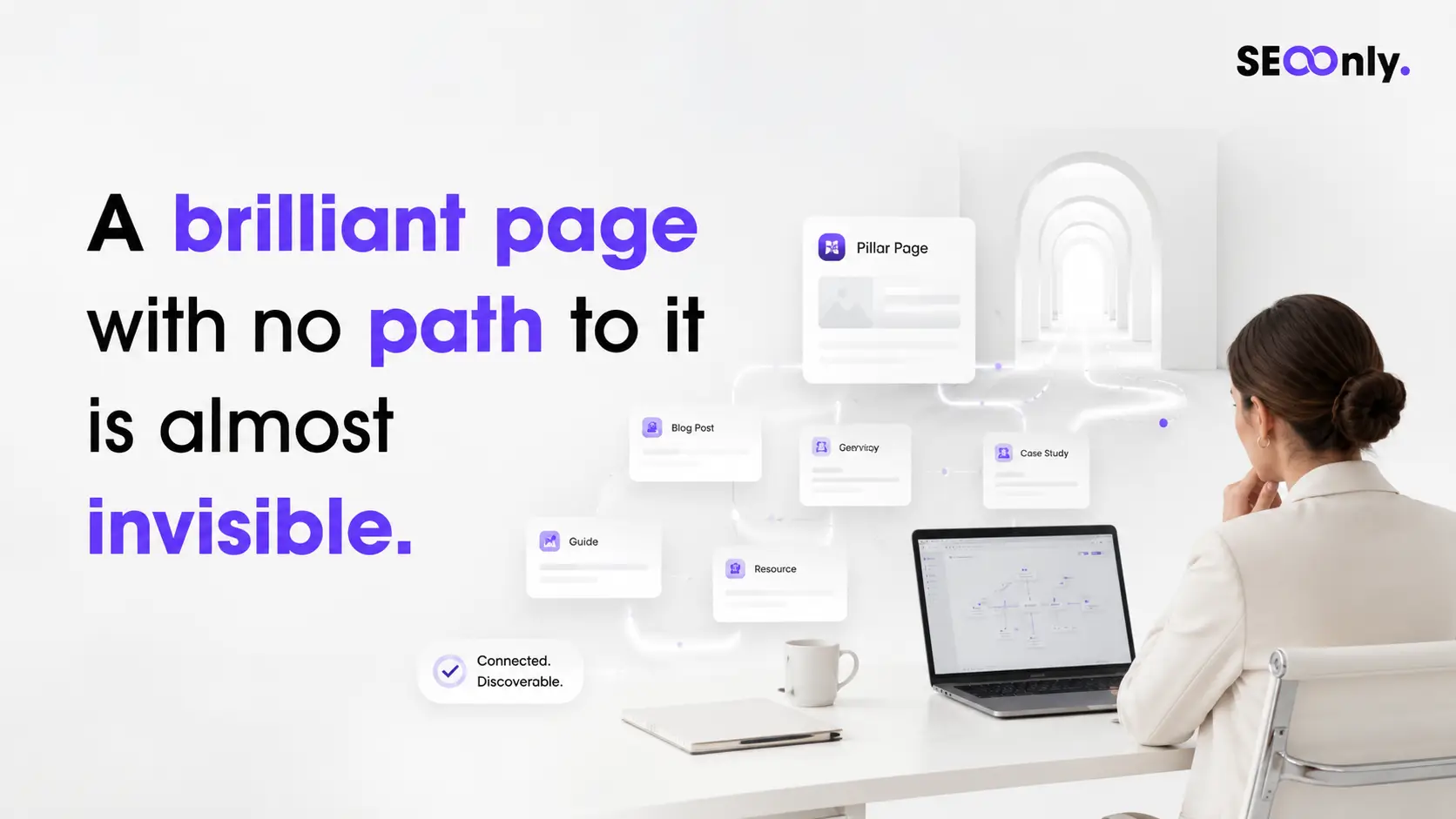
You can have a brilliant page on your website, one that answers a question perfectly, and it can still sit there getting no visitors at all. Not because it is bad. Because nothing points to it.
That is where internal linking comes in. And in 2026, with AI tools reading your site the way Google does, it matters more than it ever has.
What internal linking actually is
Let me keep this simple. Internal linking just means the links between your own pages. When your “About” page links to your “Services” page, that is an internal link. When a blog post links to your contact page, same thing.
External links go out to other websites. Internal links stay on your own. That is the whole idea.
Sounds trivial. It is not. Those links are the paths that Google and the AI tools follow to move around your site. Think of your website as a building. Your pages are the rooms. Internal links are the hallways and doorways. If a room has no door, nobody walks into it, no matter how nice it is inside.
Why this suddenly matters so much
Search has changed. You have probably seen it: that AI-written summary sitting at the very top of Google, answering the question before any website gets a click. People are also skipping the search box entirely and just asking ChatGPT, which reached 900 million people using it every week by late February 2026 (reported by TechCrunch, using OpenAI’s own figures).
Both of those tools have to read your site first. They follow the links from page to page, building a picture of what you do and which pages matter. If your important pages are buried, with nothing linking to them, they simply do not get seen. They cannot be quoted in an answer they never found.
And most pages already lose this battle. An Ahrefs study of around 14 billion pages found that 96.55% of all pages get zero traffic from Google. Zero. A big reason is that these pages are orphans: no clear path leads to them, so search engines barely notice they exist. Good internal linking is one of the cheapest ways to stay out of that 96.55%.
What good internal linking does for you
Three things, mainly.
First, it helps everything get found. When your key pages are linked to from other pages, Google and the AI crawlers can reach them and understand them. The word “crawl” just means the way these tools read your site, moving link by link.
Second, it tells machines what is important. If ten pages on your site link to your “Emergency Plumbing in Newcastle” page, that sends a loud signal: this page matters. A page nothing links to sends the opposite signal.
Third, it keeps real humans moving. A visitor who lands on your blog post and sees a helpful link to the exact service they need is far more likely to contact you than one who hits a dead end.
Here is the part owners miss. These three benefits stack on top of each other. A well-linked page gets found, gets understood as important, and gently guides the customer toward booking. A page nothing links to does none of that. So the same effort you already spent writing the page is either working for you or sitting idle, and the only difference is a few sensible links.
The mistakes I see again and again
Do not assume this is only a problem for huge websites. Small business sites get it wrong constantly. Here are the usual culprits.
- The orphan page. A service page or blog post that nothing else on the site links to. It exists, but there is no doorway. Fix it by linking to it from your menu, your homepage, or a related page.
- Vague link text. Links that say “click here” or “read more” tell a machine nothing. A link that says “book a plumber in Parramatta” tells it exactly what is on the other side. Use plain, descriptive words.
- The lonely blog. You write helpful articles, but they only link back to themselves, never to your actual services. Every good post should point the reader toward the next useful page and, where it fits, toward how you can help.
- Too many links crammed in. The opposite problem. A page stuffed with fifty links helps nobody. Link to what is genuinely relevant, not everything.
A quick example
Picture an accountant in Adelaide with a solid website. She has a fantastic page explaining tax for small business owners, clear, honest, exactly what people search for.
But nothing links to it. It is not in the menu. No blog post mentions it. The only way to reach it is to already know the exact web address, which no new visitor ever does.
So Google barely registers it, the AI tools never surface it, and it sits at zero visitors for a year. Then she adds three simple internal links: one from the homepage, one from her services menu, and one from a related blog post. Within weeks the page starts getting found. Same page. Same words. The only thing that changed was the hallways leading to it.
How to fix your own site this week
You do not need a developer or a big budget. Start here.
- List your three or four most important pages, the ones that actually win you customers.
- Check how many other pages link to each one. If the answer is “none”, that is your problem page.
- Add a few honest, descriptive internal links from related pages and from your main menu.
- Go through your blog posts and link each one to the relevant service page.
This is what AI-Powered SEO actually looks like at the technical level. Not clever tricks. Just making sure every page that matters has a clear path leading to it, so both people and machines can find it.
Because a page nobody can reach may as well not exist. And in a world where AI answers pull from what they can read, the sites with clean, sensible structure are the ones getting mentioned. Most of your competitors have never given this a second thought.
Not sure whether your best pages are actually being found?
Get a complimentary SEO review from SEOOnly. We will show you which pages are orphaned and how to fix it. No hard sell. No pressure. Get in touch.
Sources
- Ahrefs, search traffic study of ~14 billion pages (2023): ahrefs.com
- TechCrunch, “ChatGPT reaches 900M weekly active users” (Feb 2026): techcrunch.com
Related services
How SEOOnly can help
About the author
Vicky Miller
Head of SEO at SEOOnly
Vicky heads SEO at SEOOnly, helping businesses worldwide turn search visibility into measurable growth across Google and AI search. He writes on technical SEO, content strategy, and the shift to answer engines.
LinkedInLast updated September 8, 2026