
The Technical SEO Audit Checklist We Use With Every New Client
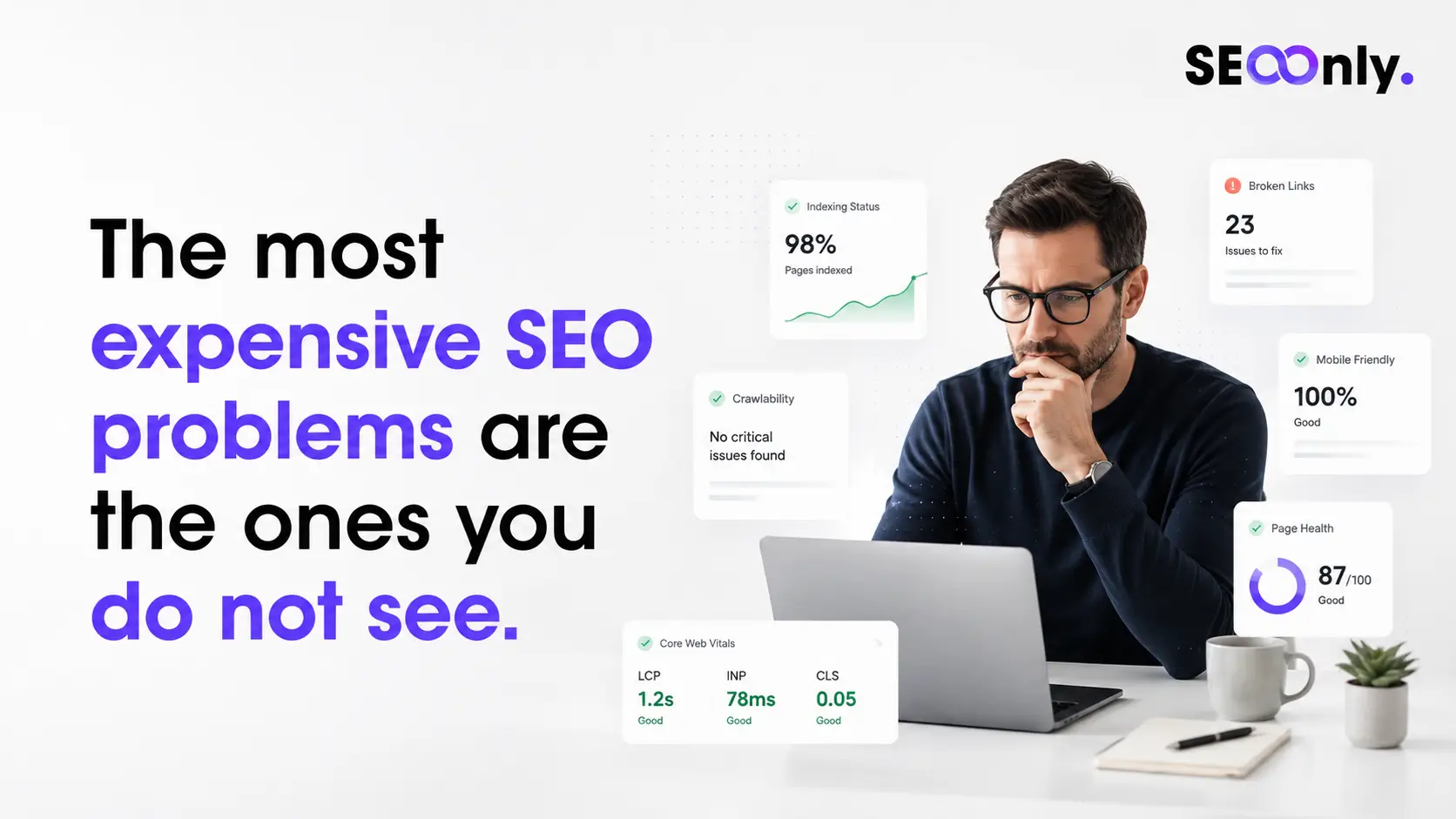
Let me ask you something. If your website had a quiet fault that was costing you customers, would you even know?
Most owners would not. The site loads for you. The phone still rings sometimes. Everything looks fine. Meanwhile a handful of hidden problems are stopping Google and AI tools from properly reading, trusting and recommending your business.
A technical SEO audit is simply a health check for the machine-readable side of your website. Not the design. The plumbing. Below is the technical SEO audit checklist we actually run for every new client, written so you can understand and even spot-check some of it yourself. Each point is a benefit, not a bit of jargon.
1. Make sure Google can find every page you care about
First we check whether Google can even reach your important pages. Google finds pages by following links, the way you click from a menu to a service page. If a page has no links pointing to it, it can sit invisible for years.
We also check for pages accidentally set to “do not show me”. A single wrong setting can hide a whole section of your site from search. It happens more than you would think, usually left over from when the site was being built.
2. Confirm your best pages are actually in Google’s library
Being found is not the same as being kept. Google files the pages it decides to keep in a giant library, called the index. If a page is not in that library, it can never appear in a search, no matter how good it is.
So we check which of your pages are filed and which are missing. When a business tells us “we never show up for our main service”, the cause is often simply that the service page was never indexed.
3. Get your site loading fast, especially on a phone
Speed is not vanity. It is money. Deloitte and Google studied 37 major sites and more than 30 million visits in their “Milliseconds Make Millions” research. Improving mobile load time by just one tenth of a second lifted retail conversions by 8.4 per cent, and lead-generation form submissions by 21.6 per cent.
Read that again. One tenth of a second changed how many people became customers. So we test your real load speed on a phone, on mobile data, not on your fast office wifi. Then we hunt down what is slowing it: oversized images, unused plugins, cheap hosting.
4. Kill the “wrong button” wobble
You know the feeling. A page loads, you go to tap something, an image drops in late, everything shifts, and you hit the wrong thing. Google now measures that instability, and customers hate it. We check whether your pages hold still as they load, and reserve space for anything that arrives late.
5. Make your site safe and trustworthy at a glance
We check that your site uses a secure connection, the little padlock in the address bar. Without it, browsers can warn visitors that your site is “not secure”, which frightens people off before they read a word. It is a basic trust signal that both customers and Google expect in 2026.
6. Fix the dead ends and broken links
A broken link is a door that leads nowhere. Visitors hit an error page, get annoyed, and leave. Google notices too. We map out every broken link and every error page, then either repair them or point them somewhere useful. Picture a cafe in Hobart whose “menu” link has quietly led to a blank error for six months. Every hungry visitor who clicked it walked away.
7. Make sure one page is not competing with itself
Sometimes the same page exists at several web addresses at once. To a person it looks like one page. To Google it can look like several near-identical copies, and it gets confused about which one to show. We sort this out with a simple tag that tells Google which version is the main one, so all the credit lands in one place.
8. Put your key information in real words, not pictures
Google and AI tools mostly read text. They struggle with words baked into an image or a photo with no description. So we check that your services, your location and your key details are written in plain text a machine can read. If your whole services page is one pretty graphic, to Google it is a blank wall.
9. Help machines understand what your business is
There is a bit of behind-the-scenes code that labels what is on your page, so machines know “this is a business, this is the phone number, these are the opening hours, this is a review”. We check whether yours is in place and correct. Done well, it helps you show up properly in Google and gives AI tools clean facts to quote about you.
10. Get the mobile experience right
Most of your customers meet you on a phone first. We go through your site on a real phone and check that text is readable without pinching, buttons are easy to tap, and nothing is cut off. A site that works on a laptop but fights the visitor on mobile is losing sales quietly, every day.
11. Tidy up so nothing important is buried
Finally we look at the shape of your whole site. Can a visitor, and a machine, get from your homepage to any important page in a click or two? If your best page is buried five clicks deep, hardly anyone reaches it, human or robot.
Why this checklist matters more than ever
Here is the sobering bit. An Ahrefs study of around 14 billion pages found that 96.55 per cent of all pages get no traffic from Google at all. Zero. Many of those pages belong to perfectly good businesses. They just have hidden technical faults that keep them invisible.
The point of an audit is not to chase a perfect score. It is to clear the obstacles so that everything else you do, your content, your reviews, your reputation, actually gets a chance to work. That is what AI-Powered SEO looks like at the foundation level. Fix the plumbing first, then build.
Want to know which of these are quietly holding your website back?
Get a complimentary technical SEO review from SEOOnly, in plain English. No hard sell. No pressure. Get in touch.
Sources
- Deloitte and Google, “Milliseconds Make Millions” (2020): web.dev
- Ahrefs, search traffic study of ~14 billion pages (2023): ahrefs.com
Related services
How SEOOnly can help
About the author
Vicky Miller
Head of SEO at SEOOnly
Vicky heads SEO at SEOOnly, helping businesses worldwide turn search visibility into measurable growth across Google and AI search. He writes on technical SEO, content strategy, and the shift to answer engines.
LinkedInLast updated September 8, 2026