How Google and AI Platforms Actually Read Your Website
Here is something most business owners never realise.
Google has never actually looked at your website. Not the way you look at it. It has never admired your logo or your hero photo. A person at Google did not visit your page, nod approvingly, and decide to rank you.
Instead, a piece of software reads your site. And now ChatGPT and other AI tools do the same thing, in their own way. If you understand roughly how they read, a lot of confusing SEO advice suddenly makes sense.
So let me walk you through it in plain English. No jargon left standing.
How search engines work, step by step
There are really only three steps, and they are easier than they sound.
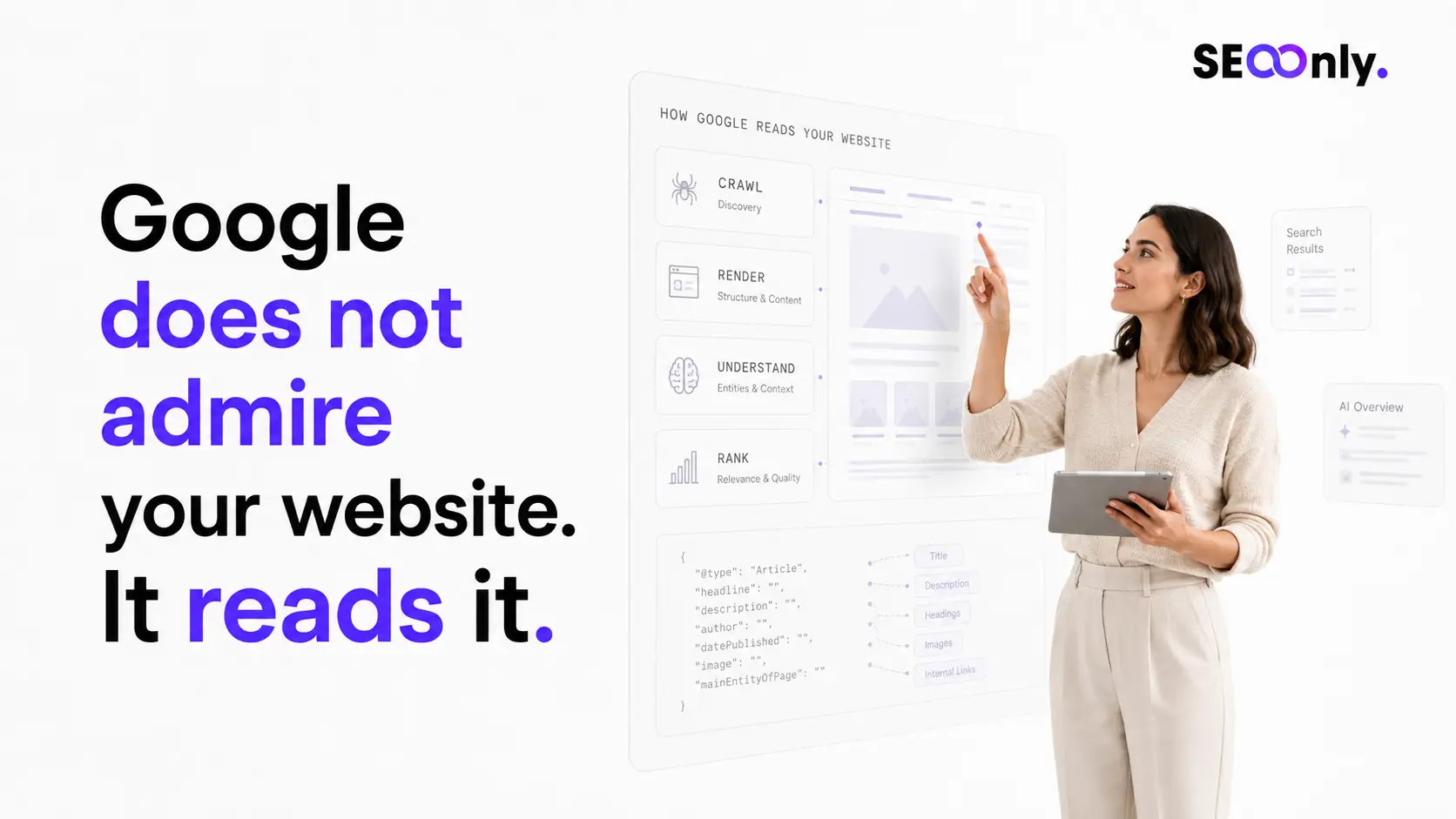
Step one: crawling. Crawling is just the way Google reads your site. Google sends out a little automated reader, sometimes called a bot, that follows links from page to page, the same way you would click around a menu. It arrives at your homepage, sees a link to your services, follows it, sees a link to your contact page, follows that. If a page has no links pointing to it, the reader may never find it at all.
Step two: indexing. Once Google has read a page, it files it away in an enormous library. That library is called the index. Being in the index simply means Google knows your page exists and roughly what it is about. Here is the catch. Being read is not the same as being filed. Google reads plenty of pages it decides not to keep.
Step three: ranking. When someone searches, Google flicks through its library and picks the pages it thinks best answer that exact question, in that exact order. That ordering is the ranking. Everyone obsesses over this step. But you cannot rank if you were never read and filed in the first place.
Crawled, indexed, ranked. Read, filed, chosen. That is how search engines work, minus the mystique.
What the reader actually sees
This is the part that trips people up, so pay attention here.
When Google reads your page, it mostly reads the words and the underlying structure, not the pretty picture you see. It reads your headings to work out what the page is about. It reads your text to understand the detail. It looks at the words you use in links.
What it cannot do well is understand a photo with no description, or text baked into an image, or a video with nothing written around it. Picture a landscaper in Geelong whose entire “services” page is one beautiful graphic. To you it is obvious. To Google it is a blank wall. There are no words to read.
Do not assume that because you can see it, a machine can. That single misunderstanding costs businesses more visibility than almost anything else.
How AI tools read differently
Now here is where 2026 gets interesting.
AI tools like ChatGPT are not just filing your page away to show later. They are reading many sources, understanding them, and then writing their own answer in their own words. When someone asks “who is a reliable electrician in Parramatta”, the AI does not hand over a list of links. It composes a reply, and it may name a few businesses inside it.
To get named, your information has to be clear, consistent and easy to understand in plain writing. If your site explains exactly what you do, where you do it, and answers the real questions customers ask, the AI has something solid to quote. If your site is vague, or buried in images, the AI has nothing to grab onto and it names someone else.
And this matters more every month. ChatGPT reached 800 million people using it every week by October 2025, and 900 million by late February 2026, according to TechCrunch reporting OpenAI’s own figures. That is a serious number of your customers asking a machine instead of scrolling a results page.
Why “just being on Google” is no longer enough
There is a quiet shift happening, and it changes the goal.
Google now often writes an AI summary at the very top of the results, answering the question before any website gets a click. A study in the United States by the Pew Research Center found that when that summary appears, people click through to an actual website only 8 per cent of the time, compared with 15 per cent when there is no summary. Only 1 per cent clicked a link inside the summary itself.
So the machine reads your site, uses what it learned to write an answer, and the customer may never visit you at all. Which means the way your site is written now feeds an answer you never see. That is a strange new reality, and it rewards businesses whose information is clean and clear.
What this means for you
You do not need to understand code. You need to make sure the machines can understand you. Here is the short version.
- Put your key information in real words, not just pictures. If it matters, write it in text.
- Use clear headings. They tell both Google and AI what each part of the page is about.
- Link your pages together so the reader can actually find them all.
- Answer the questions customers really ask, plainly. Costs, areas served, how to book.
- Keep your business name, address and phone number identical everywhere. Consistency builds trust with both Google and AI.
Here is a sobering full stop. An Ahrefs study of around 14 billion pages found 96.55 per cent of pages get no traffic from Google whatsoever. A huge share of those are not bad businesses. They are simply pages the machines could not read, understand, or trust. Do not let yours be one of them.
Get the reading part right, and everything you do to be found finally has something to stand on. That is the foundation of real AI-Powered SEO.
Want to know what Google and AI actually see when they read your site?
Get a complimentary AI visibility check from SEOOnly. No hard sell. No pressure. Get in touch.
Sources
- TechCrunch, “ChatGPT reaches 900M weekly active users” (Feb 2026): techcrunch.com
- Pew Research Center, “Google users are less likely to click on links when an AI summary appears” (US, Jul 2025): pewresearch.org
- Ahrefs, search traffic study of ~14 billion pages (2023): ahrefs.com
Related services
How SEOOnly can help
About the author
Vicky Miller
Head of SEO at SEOOnly
Vicky heads SEO at SEOOnly, helping businesses worldwide turn search visibility into measurable growth across Google and AI search. He writes on technical SEO, content strategy, and the shift to answer engines.
LinkedInLast updated September 8, 2026