Let me be direct.
The way people get answers has flipped. They used to type a question into Google, open a few websites, and read. Now, more and more, a machine reads those websites for them and just hands back the answer.
Which raises an awkward question for your business. When the machine writes that answer, is it pulling from your website, or your competitor’s?
A small, unglamorous bit of code called FAQ schema helps tip that in your favour. Let me explain what it is, and why it matters more every month.
First, what “schema” even means
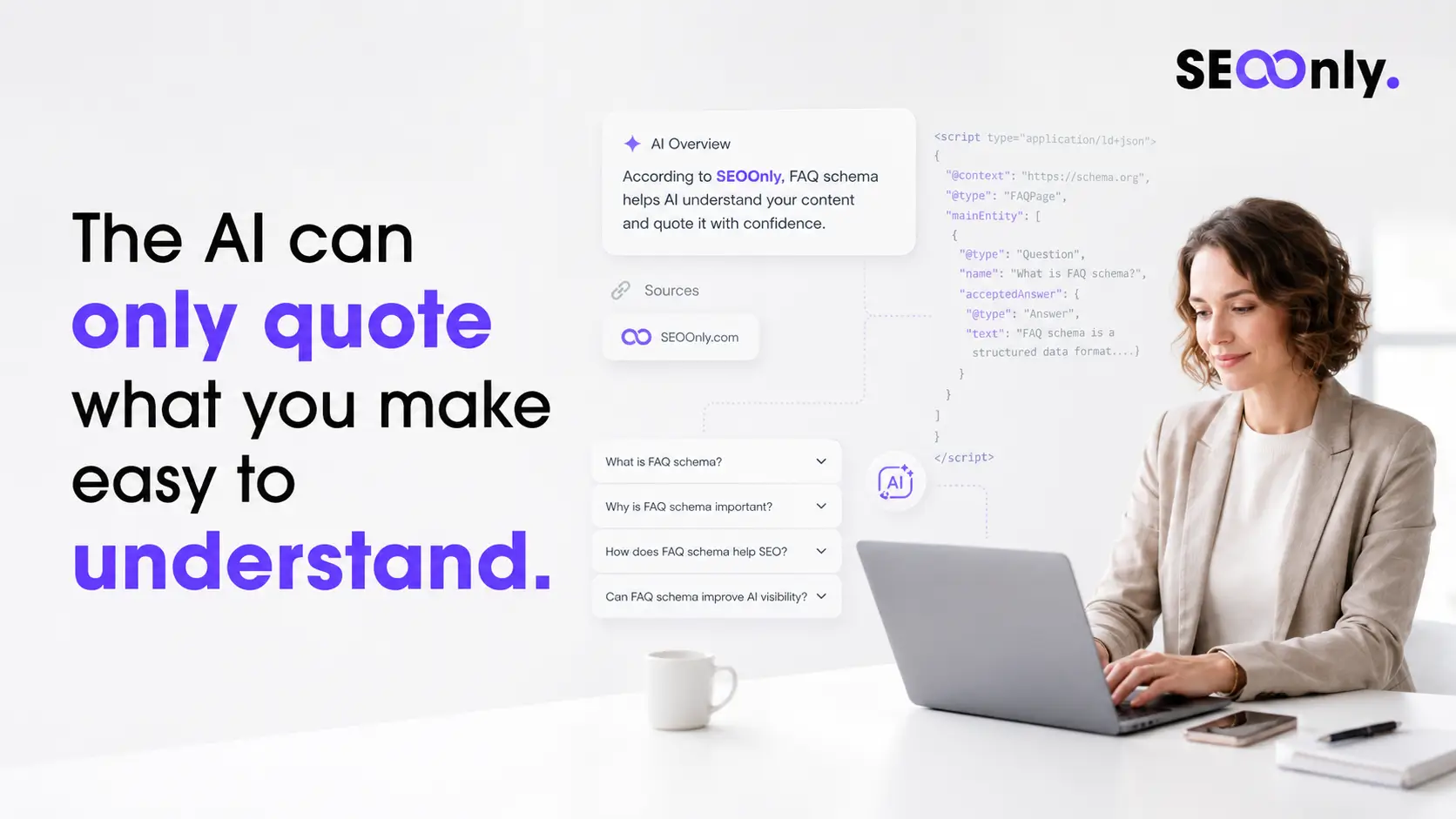
Schema is a bit of code that labels what is on your page so machines understand it. That is the whole idea. It does not change how your page looks to a human. It works quietly in the background, putting little labels on things.
FAQ schema is one specific type. It labels your questions and answers. So instead of a machine seeing a wall of text and guessing, “Is this a question? Is this the answer?”, the FAQ schema tells it plainly: this is a question, and this right here is the answer to it.
Think of it like packing a box and writing on the outside what is inside. The machine does not have to unpack everything and work it out. You have told it.
Why this matters now, not five years ago
Because the machines doing the reading have exploded in number and power.
ChatGPT reached 900 million people using it every week by late February 2026 (reported by TechCrunch, using OpenAI’s own figures). Google now puts an AI-written summary at the top of many results, answering the question before any website gets a click.
And that summary is eating the clicks. A study in the United States by the Pew Research Center found that when an AI summary appears, people click through to an actual website only 8% of the time, versus 15% when there is no summary. Almost half the clicks, gone. The AI answers, the person is satisfied, and they move on.
So the goal has shifted. It is no longer only about getting the click. It is about being the source the AI quotes when it writes the answer. If your content is clearly labelled and easy to lift, you are far more likely to be the one it uses. FAQ schema is one of the clearest ways to hand a machine an answer on a plate.
What FAQ schema actually does for you
A few practical things.
- It removes the guesswork. The machine does not have to interpret your page. You have told it exactly which text answers which question. That makes your answer easier to trust and easier to quote.
- It matches how people ask now. People do not search in keywords anymore. They ask full questions, out loud sometimes. “How much does a plumber cost for a burst pipe?” A page structured around that exact question and answer is a natural fit.
- It can improve how you look in normal results too. Well-labelled content sometimes shows extra detail in the search results, which makes your listing stand out and earns more attention.
- It forces you to answer plainly. Just writing your real FAQs, in clear language, is half the win. The code is the easy part. The clear answers are what get quoted.
A quick example
Picture two dentists in Hobart, both wanting to be recommended when someone asks an AI about the cost of a check-up.
Clinic A has a services page. Somewhere in a long paragraph, the price is mentioned. A machine reading it has to hunt, guess, and hope it grabbed the right number.
Clinic B has a proper FAQ section. The question “How much does a dental check-up cost?” sits right above a clear, direct answer, and it is labelled with FAQ schema so the machine knows exactly what it is looking at.
Now an AI gets asked that question by someone in Hobart. Which answer is easier to lift and quote with confidence? Clinic B, every time. Same information existed at both clinics. Only one of them made it easy to use.
Do not overthink it
Here is the thing. You do not need to become a coder. If your website runs on WordPress, the popular SEO plugins can add FAQ schema for you, or a good developer can set it up in an afternoon. The technical part is genuinely small.
The part that matters is the thinking behind it. Two rules keep you honest.
First, use real questions, the ones customers actually ask you. Costs, timing, guarantees, what happens if something goes wrong, whether you cover their suburb. Not questions invented to stuff in keywords.
Second, answer them properly. A clear, direct answer that genuinely helps is what gets quoted. A vague non-answer wrapped in code helps nobody, and machines are getting better at spotting the difference.
One more thing worth saying plainly. FAQ schema is not a trick to game the system, and it will not rescue a page that has nothing useful on it. Think of it as good labelling on genuinely good content. The content earns the trust. The schema just makes sure the machine can find and lift it without a struggle. Get both right and you are doing something most of your competitors are not.
Where to start this week
You can make real progress in an hour.
- Write down the ten questions customers ask you most often. Your inbox and your phone calls already have the list.
- Answer each one in a couple of honest, plain sentences.
- Add them as a clear FAQ section on the relevant page, not buried at the bottom of the site.
- Ask your developer or SEO plugin to apply FAQ schema so the labels are in place.
That is it. This is what AI-Powered SEO looks like in practice. Not magic. Just answering the real questions clearly, then labelling them so a machine can read them without guessing.
Because the businesses being named in AI answers are not always the biggest or the oldest. Often they are simply the ones who made their answers the easiest to find and quote. Most of your competitors still have their best answers buried in a paragraph nobody, human or machine, wants to dig through.
Want to know if AI tools can actually read and quote your answers?
Get a complimentary AI visibility check from SEOOnly. We will look at how your content is labelled and where it is losing out. No hard sell. No pressure. Get in touch.
Sources
- TechCrunch, “ChatGPT reaches 900M weekly active users” (Feb 2026): techcrunch.com
- Pew Research Center, “Google users are less likely to click on links when an AI summary appears” (US, Jul 2025): pewresearch.org
Related services
How SEOOnly can help
About the author
Vicky Miller
Head of SEO at SEOOnly
Vicky heads SEO at SEOOnly, helping businesses worldwide turn search visibility into measurable growth across Google and AI search. He writes on technical SEO, content strategy, and the shift to answer engines.
LinkedInLast updated September 8, 2026