
Duplicate Content and Canonical Tags: Why AI Platforms Punish Confusion
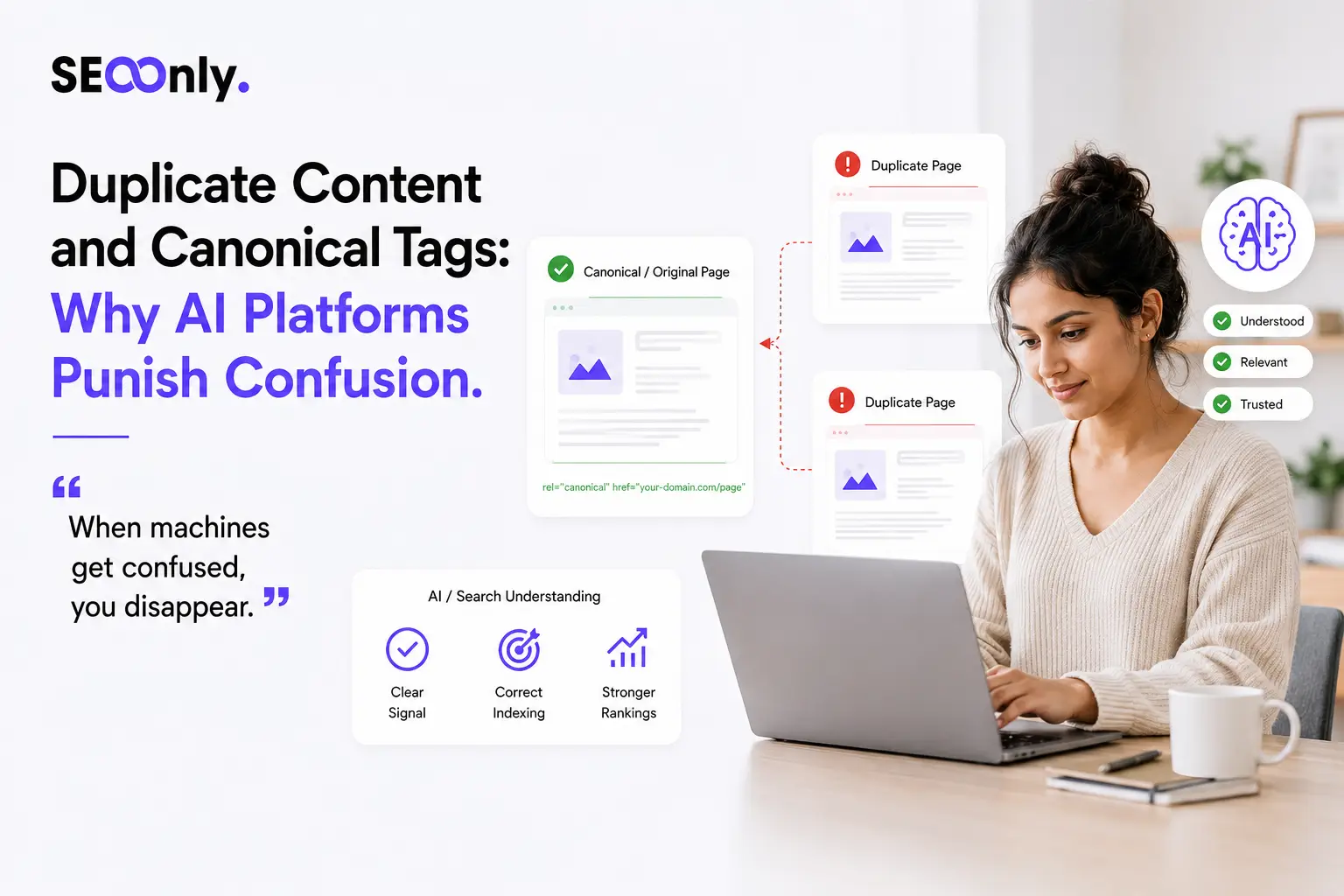
Here is the thing about machines. They hate being confused.
When Google or an AI tool reads your website and finds the same content in three slightly different places, it has to make a decision it should never have had to make: which one of these is the real page? And when a machine has to guess, you lose control of the outcome.
This is the quiet problem of duplicate content, and the simple fix is something called a canonical tag. Let me explain both in plain English.
What duplicate content actually is
Duplicate content just means the same, or nearly the same, content showing up at more than one web address on your site.
You might be thinking, “I would never copy my own pages.” And you probably did not, on purpose. The trouble is that websites create duplicates on their own, without anyone noticing. A few common ways it happens:
- Your site works with “www” in front and also without it, so the same page technically lives at two addresses.
- An online shop shows the same product under several categories, each with its own web address.
- A printer-friendly version, or a version with tracking bits added to the end of the address, counts as a separate page.
- Someone rebuilt a page, the old one never got removed, and now two near-identical versions exist.
To you they are all just “the page”. To a machine reading the site, they look like several competing pages saying the same thing. That is where the confusion starts.
What a canonical tag does
A canonical tag is a tag that tells Google which version of a page is the main one. That is the whole job.
It is a small, invisible label in the code. A human visitor never sees it. But it says to a machine: “Of all these similar pages, this one right here is the original, the one that counts. Treat the others as copies of it.”
Think of it like a bunch of photocopies with one clearly stamped ORIGINAL. Now the machine knows which to trust, which to file, and which to quietly ignore. No guessing required.
Why this matters more in the AI era
For years this was mostly a Google housekeeping issue. Now the stakes are higher, because a new set of readers has arrived.
When someone asks ChatGPT or Google’s AI a question, those tools read real web pages to build the answer, and ChatGPT alone reached 900 million people using it every week by late February 2026 (reported by TechCrunch, using OpenAI’s own figures). These tools want one clear, confident source to quote. Confusion is the enemy of confidence.
Picture an AI reaching your site and finding three near-identical versions of your main service page. Which one does it quote? It might pick a stripped-down printer version. It might pick an old one with the wrong price. It might split the trust between all three so none of them looks strong, and reach for a competitor with one clean, obvious page instead.
That is what “punishing confusion” really means. Not a formal penalty. Something quieter and worse: your clearest message gets diluted, and the tool goes with whoever was easier to understand.
And the machine will not tell you any of this happened. There is no warning, no email, no red flag in your inbox. You simply keep publishing good work while it quietly competes against itself, and you never see the mention you missed. That is exactly why so many owners have this problem for years without knowing.
The hidden cost you never see
Do not assume this only bites big online shops. It hits small business sites constantly, and the damage is invisible, which is what makes it dangerous.
An Ahrefs study of around 14 billion pages found that 96.55% of all pages get zero traffic from Google. Duplicate, confused pages are a real contributor to that graveyard. When your effort is split across three copies of the same page, none of them builds up the strength that one focused page would have. You did the work. It just got scattered.
Picture a solicitor in Perth with a strong page on wills and estates. Except a rebuild left an old copy live, and the site answers on both “www” and the plain version. So four addresses now show roughly the same page. Any trust and links the page earns get spread thin across all four. One clean page pointing to itself with a canonical tag would have stood far taller. Same content, wildly different result.
How to sort it out
You do not need to touch code yourself. You need to know what to look for and what to ask for.
- Pick one address style and stick to it. Decide whether your site uses “www” or not, and make every version point to the one you chose. Your developer can set this up once and it is done.
- Find your accidental copies. Old pages left live after a rebuild, duplicate product pages, stray versions. List them.
- Point the canonical tag at the real page. For each set of near-identical pages, make sure the canonical tag names the one true version. If your site runs on WordPress, the popular SEO plugins handle this, and a developer can confirm it is set correctly.
- Remove what should not exist. If an old page serves no purpose, redirect it to the current one so nobody, human or machine, lands on the dead version.
The simple takeaway
Machines reward clarity and punish confusion. A canonical tag is one of the cheapest, quietest ways to give them clarity.
This is what AI-Powered SEO looks like beneath the surface. Not clever tricks. Just making sure that when Google or an AI tool reads your site, there is one obvious, authoritative version of each page, so all your effort points in one direction instead of being split three ways.
Here is the honest part. Most of your competitors have duplicate content quietly bleeding their strength right now and have no idea. Sort yours out, and you hand the machines exactly what they want: one clear page to trust, and to quote.
Worried your website is confusing Google and the AI tools with duplicate pages?
Get a complimentary SEO review from SEOOnly. We will find the duplicates and show you the fix. No hard sell. No pressure. Get in touch.
Sources
- Ahrefs, search traffic study of ~14 billion pages (2023): ahrefs.com
- TechCrunch, “ChatGPT reaches 900M weekly active users” (Feb 2026): techcrunch.com
Related services
How SEOOnly can help
About the author
Vicky Miller
Head of SEO at SEOOnly
Vicky heads SEO at SEOOnly, helping businesses worldwide turn search visibility into measurable growth across Google and AI search. He writes on technical SEO, content strategy, and the shift to answer engines.
LinkedInLast updated September 8, 2026