
Page Speed and AI Crawlers: What Is Actually Different in 2026
Let me ask you something. How long are you willing to wait for a website to load before you give up and try another one?
Two seconds? Three? For most people it is barely that. And here is the uncomfortable part: your customers are exactly the same about your site.
Page speed, which just means how fast your website loads, has always mattered. But in 2026 there is a new reader in the room, and it changes the stakes. Let me explain plainly.
The old reason speed mattered, and it still does
Before we get to the AI part, do not lose sight of the obvious one. A slow website loses customers and money. Full stop.
The best proof of this comes from Deloitte and Google, who ran a study called “Milliseconds Make Millions”. They looked at 37 major brand sites and more than 30 million visits. What they found is striking. A tiny 0.1 second improvement in mobile load time, a tenth of a second, increased retail conversions by 8.4%, and travel conversions by 10.1%. For businesses collecting enquiries, lead-generation form submissions jumped by 21.6%. The average order value in retail rose 9.2% too.
Read that again. A tenth of a second. That is faster than a blink, and it moved real money. Now imagine your site is not a tenth of a second slow, but four seconds slow. The bleeding is not small.
A “conversion” here just means a visitor doing the thing you wanted: buying, booking, or filling in your enquiry form.
What is genuinely new in 2026
Here is the shift. It is not just people visiting your site now. It is machines.
When you ask ChatGPT or Google’s AI a question, those tools often go out and read live web pages to build their answer. The word “crawler” just means one of these automated readers that visits your site to collect information. ChatGPT alone reached 900 million people using it every week by late February 2026 (reported by TechCrunch, using OpenAI’s own figures), and a lot of what those people ask involves the AI reading real websites in the background.
These AI crawlers are busy and impatient in their own way. They have billions of pages to get through. If your page is slow to respond, or heavy and tangled to load, a crawler can time out or grab only part of it before moving on. And if it only grabbed part of your page, the part with your prices or your service area might be the bit it missed.
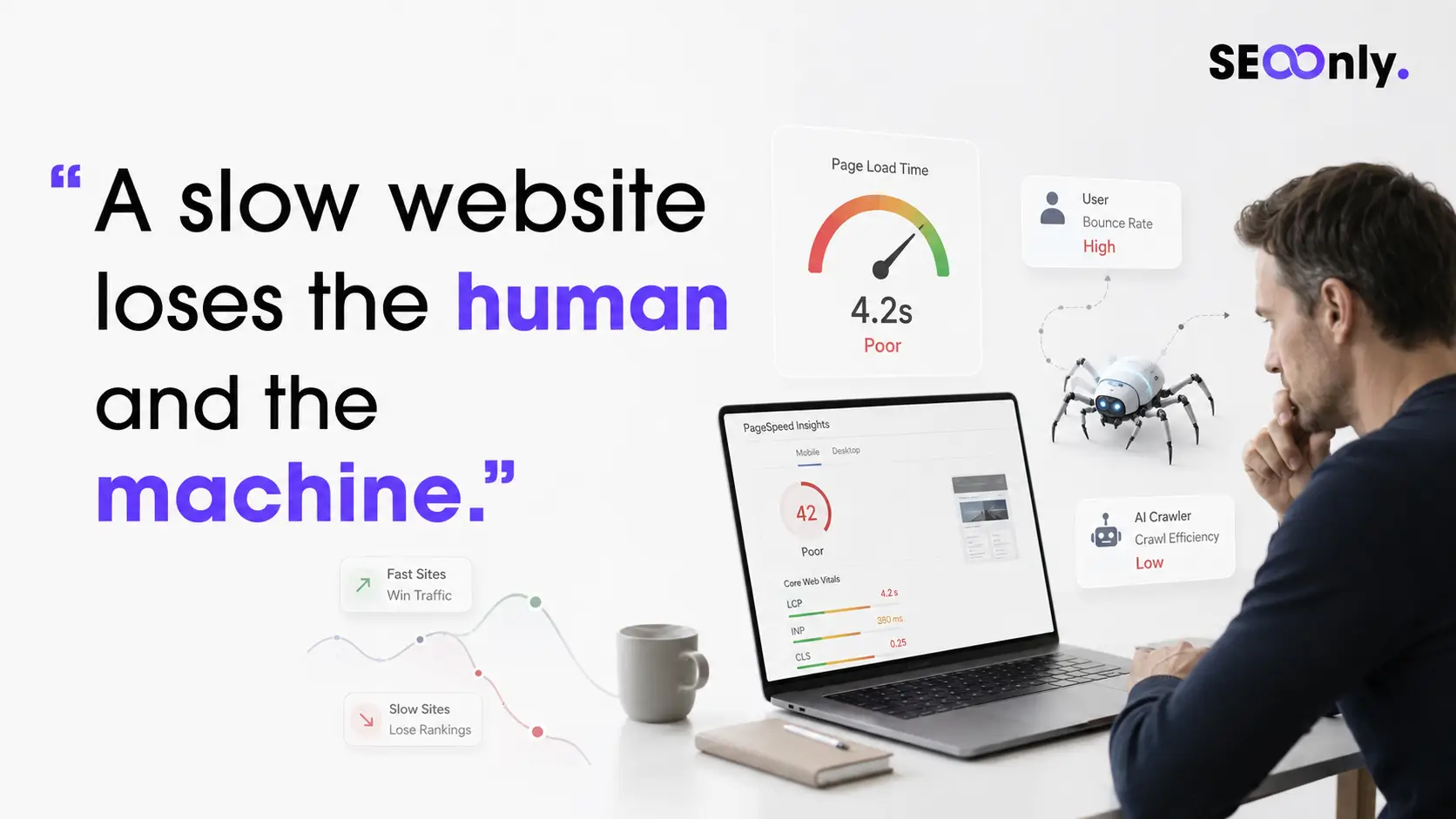
So slow speed now costs you twice. It loses the human who could not wait, and it makes your site harder for the AI to read and quote. You can be invisible to a customer and to the machine that customer is asking, at the same time.
Why the AI angle raises the stakes
Think about what happens when the AI struggles with your site.
It does not send you an error message. It does not try again politely. It just uses a competitor whose page loaded cleanly and quickly. You never find out you were passed over. There is no complaint, no bounce report you will notice, just a quiet absence from the answer.
Picture a removalist in Toowoomba with a beautiful but bloated website: huge uncompressed photos, a dozen slow-loading widgets, the works. A customer asks an AI for a good local removalist. The AI reaches out, the page crawls along, and the tool moves on to the two competitors whose sites answered instantly. Same service, same town. One got named. One did not, and never knew why.
And this is not a once-off. Every time a customer asks a machine a question your business could have answered, the same silent contest plays out. A fast site keeps winning it. A slow one keeps losing it, quietly, day after day, with no scoreboard you ever get to see.
What actually makes a site slow
The good news is that the usual culprits are boring and fixable. You do not need to understand the code to know what to ask your developer about.
- Massive images. The single most common cause. A photo saved straight off a phone can be many times larger than it needs to be. Properly sized and compressed images often fix half the problem on their own.
- Too many plugins and add-ons. Every extra tool you bolt on has to load. Some are worth it. Many are quietly dragging your site down and can go.
- Cheap, overcrowded hosting. Hosting is the service that stores your website and serves it up. If yours is slow or overloaded, everything is slow. It is often the cheapest fix with the biggest payoff.
- No caching. Caching just means saving a ready-made copy of your page so it loads instantly next time instead of being rebuilt from scratch. Turning it on is usually simple.
How to check yours honestly
Do not guess, and do not trust how fast it feels on your own phone, on your own wifi, with the site already loaded. That is the fastest it will ever look.
- Test it on mobile, on a normal phone connection, ideally somewhere with average signal.
- Test the pages that actually matter, your key service pages and your contact page, not just the homepage.
- Ask a straight question: does it feel instant, or do you find yourself waiting? If you are waiting, your customers are too.
- Then get someone to check the technical culprits above and tackle the biggest ones first.
This is what AI-Powered SEO looks like at the technical level. Not a clever trick. Just making sure your site loads fast enough that both a busy human and a busy machine can actually use it.
Here is the thing. Speed used to be about keeping customers from leaving. Now it is also about being readable to the tools those customers ask. The businesses treating a fast site as normal, not a luxury, are the ones showing up in both places. And a tenth of a second, as Deloitte showed, is worth more than most owners ever imagine.
Wondering if a slow site is quietly costing you customers and AI mentions?
Get a complimentary SEO review from SEOOnly. We will check your speed and show you the biggest fixes. No hard sell. No pressure. Get in touch.
Sources
- Deloitte and Google, “Milliseconds Make Millions” (2020): web.dev
- TechCrunch, “ChatGPT reaches 900M weekly active users” (Feb 2026): techcrunch.com
Related services
How SEOOnly can help
About the author
Vicky Miller
Head of SEO at SEOOnly
Vicky heads SEO at SEOOnly, helping businesses worldwide turn search visibility into measurable growth across Google and AI search. He writes on technical SEO, content strategy, and the shift to answer engines.
LinkedInLast updated September 8, 2026