
Crawl Budget Explained: Why It Matters for Large, Fast-Growing Websites
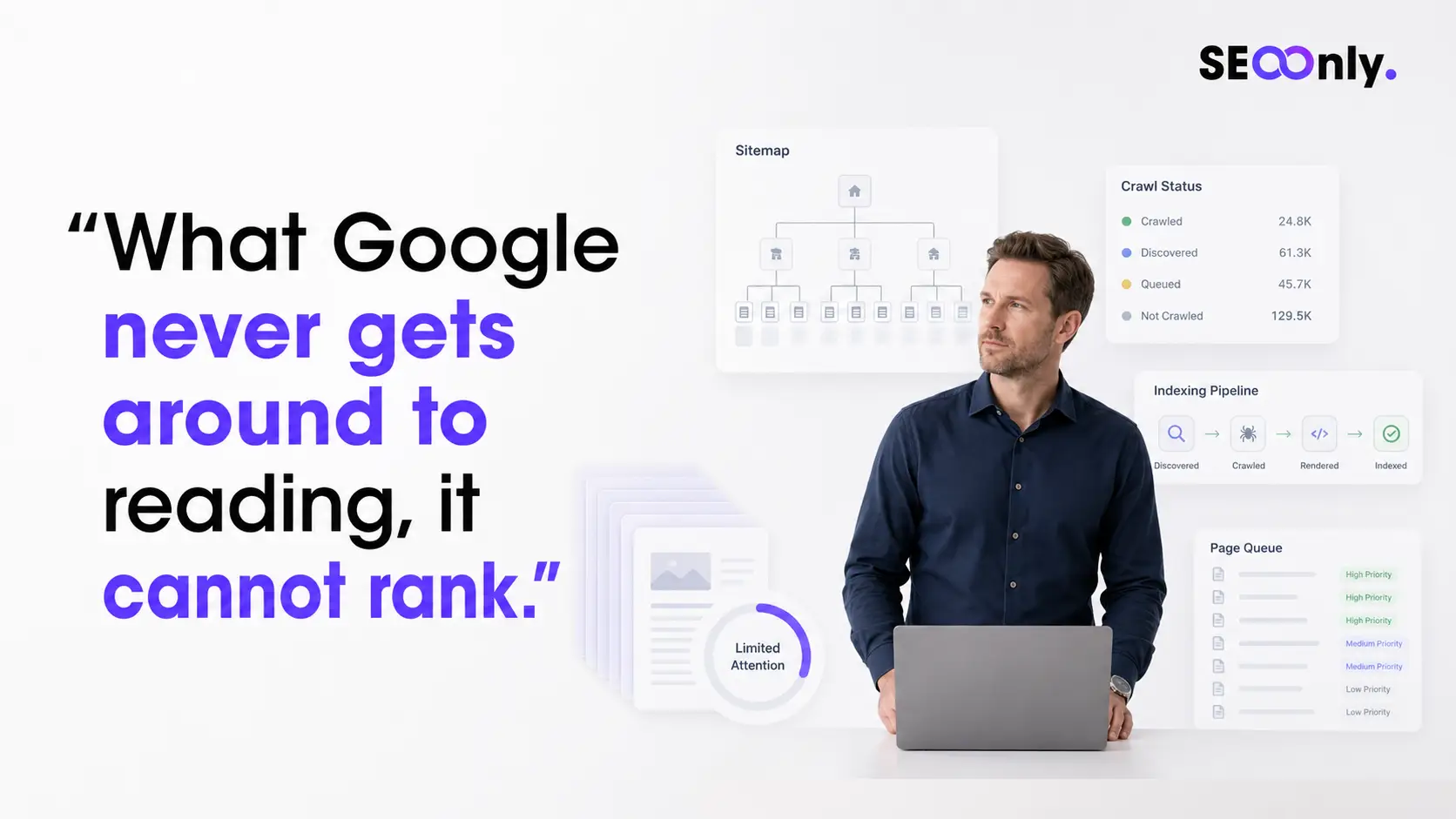
Here is the thing. Google does not have unlimited time for your website.
That surprises people. We imagine Google reads every page the instant it goes live. For a small site, more or less, it does. But for a large or fast-growing website, there is a limit to how much Google will read on any visit. That limit has a name: crawl budget.
If you run a big website, an online shop with thousands of products, a property portal, a directory, a busy publisher, this quietly decides which of your pages Google actually sees. And what it never gets around to reading, it cannot rank. Let me explain it properly, without the jargon.
The library analogy
Think of Google as a librarian with a very big job and limited hours.
Every day this librarian walks around the web, reading pages and deciding which ones to add to the library so people can find them later. Reading a page is called crawling. Crawling is simply the way Google reads your site, page by page.
Now, the librarian cannot read every page on the internet every day. There is too much of it. So for each website, they give a certain amount of attention. Maybe they read 200 of your pages today, maybe 2,000, depending on how big and how trusted your site is. That daily allowance of attention is your crawl budget.
Here is the key point. If your website has 10,000 pages, and the librarian only gets through a slice of them before moving on, some of your pages might wait days or weeks to be read. Brand new pages included. A product you added this morning might not be findable on Google for a while, because the librarian has not reached it yet.
Why small sites can ignore this
Let me be honest, because plenty of “experts” try to scare small businesses about this. If you run a plumbing business in Newcastle with 25 pages, crawl budget is not your problem. The librarian reads your whole site easily, with time to spare. You should spend your energy on speed, content and reviews instead.
Crawl budget only starts to matter once a site gets large, or adds new pages very fast, or both. So who should actually care?
- Online shops with thousands of products, sizes and colour variations.
- Property, jobs or car listing sites, where new listings appear constantly.
- Directories and marketplaces with tens of thousands of pages.
- Busy news or publishing sites posting many articles a day.
If that is you, read on. This is where real money leaks away.
How websites waste their crawl budget
Here is what goes wrong. The librarian’s limited time gets spent on rubbish pages instead of your important ones. Picture the librarian spending all afternoon reading blank pages and duplicates, then running out of time before reaching your best new products. That is exactly what happens on many large sites.
The usual culprits are these.
- Near-identical copies of the same page. A shop filter that creates a fresh web address every time someone sorts by price or colour can spin up thousands of almost-identical pages. The librarian reads them all and wastes the day.
- Dead ends and error pages. Broken links and pages that lead nowhere. Every one the librarian visits is time not spent on a real page.
- Endless low-value pages. Old tag pages, empty search results, expired listings that were never cleaned up.
- A slow website. This one is sneaky. If each page is slow to load, the librarian reads fewer pages in the same visit. Slow site, smaller effective budget.
Do not assume more pages is better. On a large site, thousands of thin, pointless pages actively hurt you by soaking up the attention your good pages needed.
Why this hits your bottom line
Let me connect it to money, because that is what matters.
An Ahrefs study of around 14 billion pages found that 96.55 per cent of all pages get no traffic from Google at all. On a big site, a real chunk of that is pages Google simply never read properly, or read so late they missed their moment. A concert ticket page crawled the week after the show sold out is worthless.
Speed ties in here too. Deloitte and Google, in their “Milliseconds Make Millions” study of 37 major sites, found that improving mobile load time by just one tenth of a second lifted retail conversions by 8.4 per cent. A faster site does not only convert better. It also lets Google read more of your pages per visit. You win twice.
What to actually do about it
You do not need to touch code. You need to know what to ask your web team for. Here is the plain-English version.
- Point Google at the pages that matter. A simple site map, a list of your important pages, helps the librarian go straight to what counts.
- Stop the machine from wasting time on junk. Ask your developer to keep Google away from filter combinations, internal search results and other low-value pages.
- Clean up duplicates. Where the same page exists at several addresses, tell Google which one is the main version so the others do not eat the budget.
- Remove or fix dead pages. Repair broken links and clear out expired listings that lead nowhere.
- Speed the site up. Faster pages mean Google reads more of them each visit. This helps everything.
- Link your important pages well. A page buried deep with nothing pointing to it may rarely get read. Bring it closer to the surface.
The bottom line
Crawl budget is not something to panic about, and for most small Australian businesses it never comes up. But if you run a large or fast-growing website, it can be the quiet reason your newest and most valuable pages are not showing up.
The fix is not fancy. It is good housekeeping. Guide Google to your best pages, stop it wasting time on the rubbish, and keep the whole thing fast. That is what smart AI-Powered SEO looks like on a big site. Make every visit from the librarian count, and make sure it is always spent on the pages that actually earn you money.
Running a big site and wondering if Google is even reading your best pages?
Get a complimentary crawl and SEO review from SEOOnly, in plain English. No hard sell. No pressure. Get in touch.
Sources
- Ahrefs, search traffic study of ~14 billion pages (2023): ahrefs.com
- Deloitte and Google, “Milliseconds Make Millions” (2020): web.dev
Related services
How SEOOnly can help
About the author
Vicky Miller
Head of SEO at SEOOnly
Vicky heads SEO at SEOOnly, helping businesses worldwide turn search visibility into measurable growth across Google and AI search. He writes on technical SEO, content strategy, and the shift to answer engines.
LinkedInLast updated September 8, 2026