Here is something most NDIS providers never realise. You can rank at the top of Google and still lose the enquiry.
Getting found is only half the job. A family lands on your page, and in a few seconds they make a quiet decision: do I trust these people with someone I love, or not? If the answer is not, it does not matter how many keywords you stuffed onto the page. They are gone.
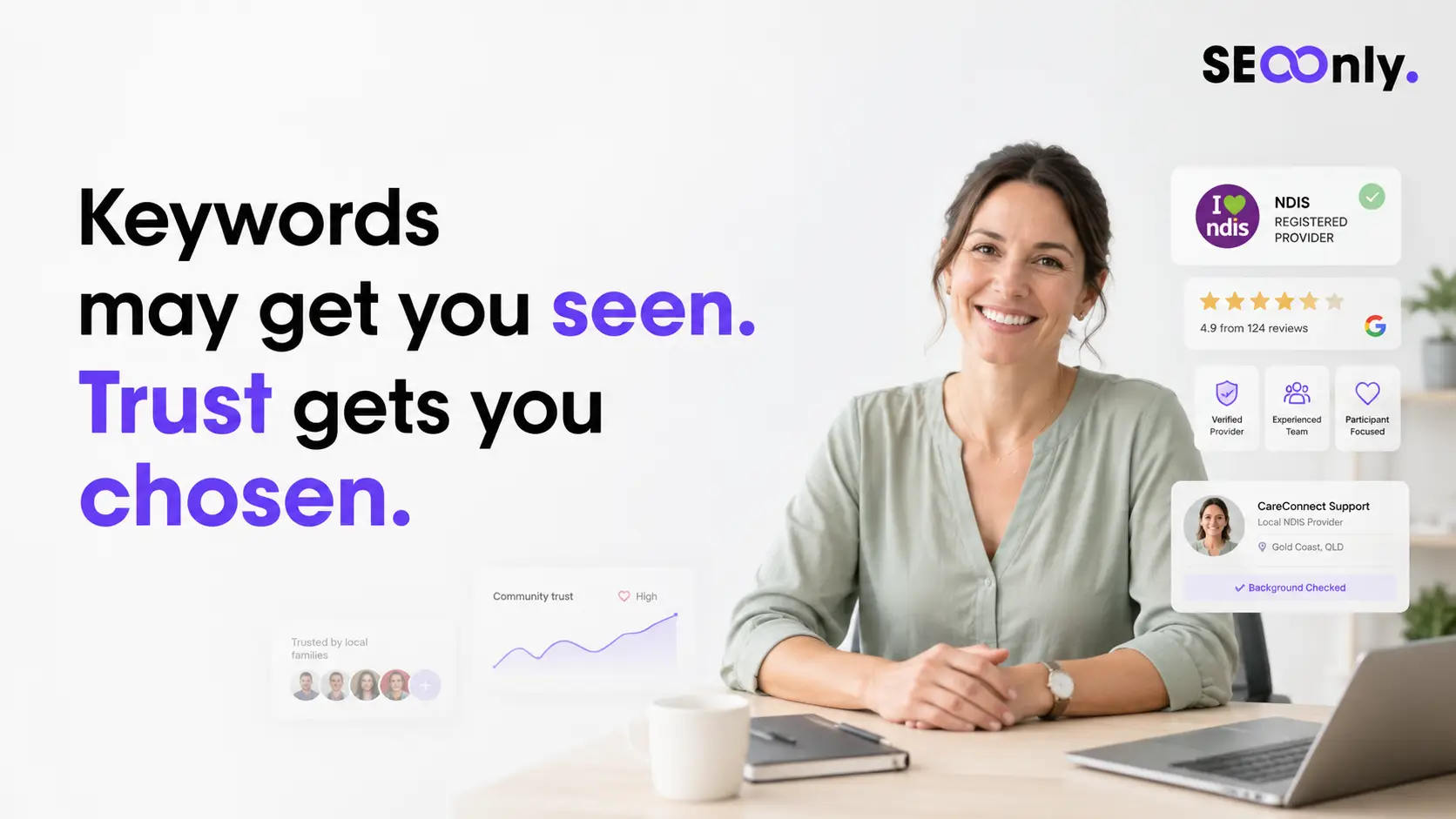
This is what a lot of NDIS marketing gets backwards. It obsesses over keywords and rankings and forgets the thing that actually converts a nervous parent into a phone call. Trust. In disability support, trust is not a nice extra. It is the whole game.
Why NDIS is different from every other local business
When someone searches for a plumber, they want a fast, fair fix. When a family searches for an NDIS provider, they are handing over the care of a vulnerable person. The stakes could not be more different.
And the audience is huge. The NDIS Quarterly Report to 31 March 2025 recorded 717,001 active participants, up more than 24,000 in one quarter. Behind most of them is a carer doing careful, anxious research. These families are not looking for the cheapest or the flashiest. They are looking for the safest. The provider who feels most trustworthy wins, even if a rival ranks higher.
So the real question in NDIS marketing is not just “how do we get found”. It is “once we are found, do we look like someone a worried parent can rely on”.
The myth: keywords are what get you chosen
Let me be direct about a common myth. A lot of providers believe SEO is about repeating “NDIS provider Brisbane” as many times as possible until Google gives in.
That is not how it works, and it never really did. Google does try to show the most relevant page, yes. But it also weighs whether people trust and engage with your site. And even when a keyword-heavy page does rank, it often reads like it was written for a machine, not a human. A family lands on it, feels nothing, and leaves. You won the ranking and lost the person.
The providers winning enquiries are not the ones who gamed the keywords. They are the ones whose pages make a family exhale and think, finally, someone who gets it.
The trust signals that actually win the enquiry
So what makes a family trust you enough to reach out? These are the signals that do the heavy lifting.
- Genuine reviews from other families. Nothing reassures a parent like another parent. BrightLocal’s 2025 survey found 84% of people use Google to read reviews, and 96% are willing to write one if asked. A few honest words from local families outweigh every marketing slogan you could write.
- Clear information about who you are. Real names, real faces, your team, your experience, your registration status. Anonymity reads as risk. A worried family wants to see the people behind the service.
- Plain answers to the scary questions. How you keep people safe. What happens if a worker is sick. How you match staff to a participant. Answer the fears directly and you remove the reasons to hesitate.
- Consistency everywhere. Your name, address and phone matching across your website, your Google Business Profile and every directory. Whitespark’s research shows this consistency is a real ranking factor, and it also quietly signals you are an established, legitimate operation.
- A human tone. Writing that sounds like a caring person, not a brochure. Families can feel the difference in one paragraph.
Trust is now a ranking factor too
Here is the part that ties it together. The trust signals that win over families are increasingly the same signals that win over Google and the AI tools.
Whitespark’s Local Search Ranking Factors research has found for years that Google Business Profile signals and reviews are among the strongest factors for showing up locally, and that review recency matters. In other words, the reviews that reassure a nervous parent also lift where you appear in the first place. Trust and visibility are no longer separate jobs. They are the same job.
The same is true for AI search. More families now ask ChatGPT or read Google’s AI summary before choosing. ChatGPT reached 900 million weekly users by late February 2026, reported by TechCrunch. Those tools pull from clear, credible, well reviewed sources. A page thick with keywords but thin on substance gives them nothing to quote. A page that plainly earns trust gives them everything.
What this looks like in practice
Picture two support coordinators in Parramatta.
The first has a page crammed with “NDIS support coordinator Parramatta” over and over, a stock photo, and no reviews. It ranks reasonably. But a parent reading it feels nothing and clicks away.
The second has fewer keywords but real photos of the team, a plain explanation of how they support families, registration details stated clearly, and eight genuine reviews from local participants. A parent reads it, feels reassured, and rings.
Same suburb. Same participants searching. The second provider wins, not because they out-optimised anyone, but because they were trustworthy on the page. And over time, because those reviews and that engagement please Google too, the second provider climbs above the first anyway. Trust does not cost you rankings. It earns them.
So here is the shift worth making. Stop treating NDIS marketing as a game of keywords and start treating it as a job of earning trust in public. Collect the reviews. Show the real people. Answer the hard questions plainly. Keep your details consistent everywhere. Do that, and you win the enquiry and the ranking, because in disability support they were always the same thing.
Want to know whether your website earns a family’s trust in the first ten seconds?
Get a complimentary SEO review from SEOOnly. No hard sell. No pressure. Get in touch.
Sources
- NDIS Quarterly Report (31 March 2025): ndis.gov.au
- BrightLocal, Local Consumer Review Survey (2025): brightlocal.com
- Whitespark, Local Search Ranking Factors: whitespark.ca
- TechCrunch, “ChatGPT reaches 900M weekly active users” (Feb 2026): techcrunch.com
Related services
How SEOOnly can help
About the author
Vicky Miller
Head of SEO at SEOOnly
Vicky heads SEO at SEOOnly, helping businesses worldwide turn search visibility into measurable growth across Google and AI search. He writes on technical SEO, content strategy, and the shift to answer engines.
LinkedInLast updated September 8, 2026