How NDIS Participants and Families Actually Search for Providers in 2026
Let me ask you something. When a family finally decides they need a new support worker, or a plan manager, or an occupational therapist for their child, where do they actually start?
It is almost never a phone book. It is rarely a cold call. In 2026, it starts with a search, and it usually starts on a phone, often late at night after a long day.
Here is the thing most NDIS providers get wrong. They think choosing a provider is one decision. It is not. It is a careful, cautious journey, and families check you at every step. If you understand that journey, you can be there at each point. If you do not, you lose people you never even knew were looking.
This is a big, active audience
First, the scale. The NDIS Quarterly Report to 31 March 2025 recorded 717,001 active participants, up 24,178 in a single quarter. Behind each of those participants is often a parent, a partner or a carer doing the searching. That is a large and growing number of people looking for support right now, and many of them are looking for someone new because their last provider did not work out.
These are not casual searchers. A family choosing a support worker is trusting someone with a person they love. They do not pick the first result and hope. They research. And that changes everything about how you need to show up.
Step one: they search, and they do it on a phone
The journey starts with a search like “NDIS support coordinator near me” or “speech therapy for kids NDIS Adelaide”.
BrightLocal’s 2026 research found 84% of people had searched for a local business online in the past three months, and 73% did it on a mobile. For NDIS families that mobile number is likely even higher. They are searching between appointments, in waiting rooms, on the couch after the kids are asleep.
What this means for you is simple but often ignored. If your site is slow, hard to read on a phone, or buries the one thing they need, you are already out. They will not persevere. They will tap back and try the next provider.
Step two: they check whether you are legitimate
This is the step other industries do not have to worry about as much, and it is the one that matters most here.
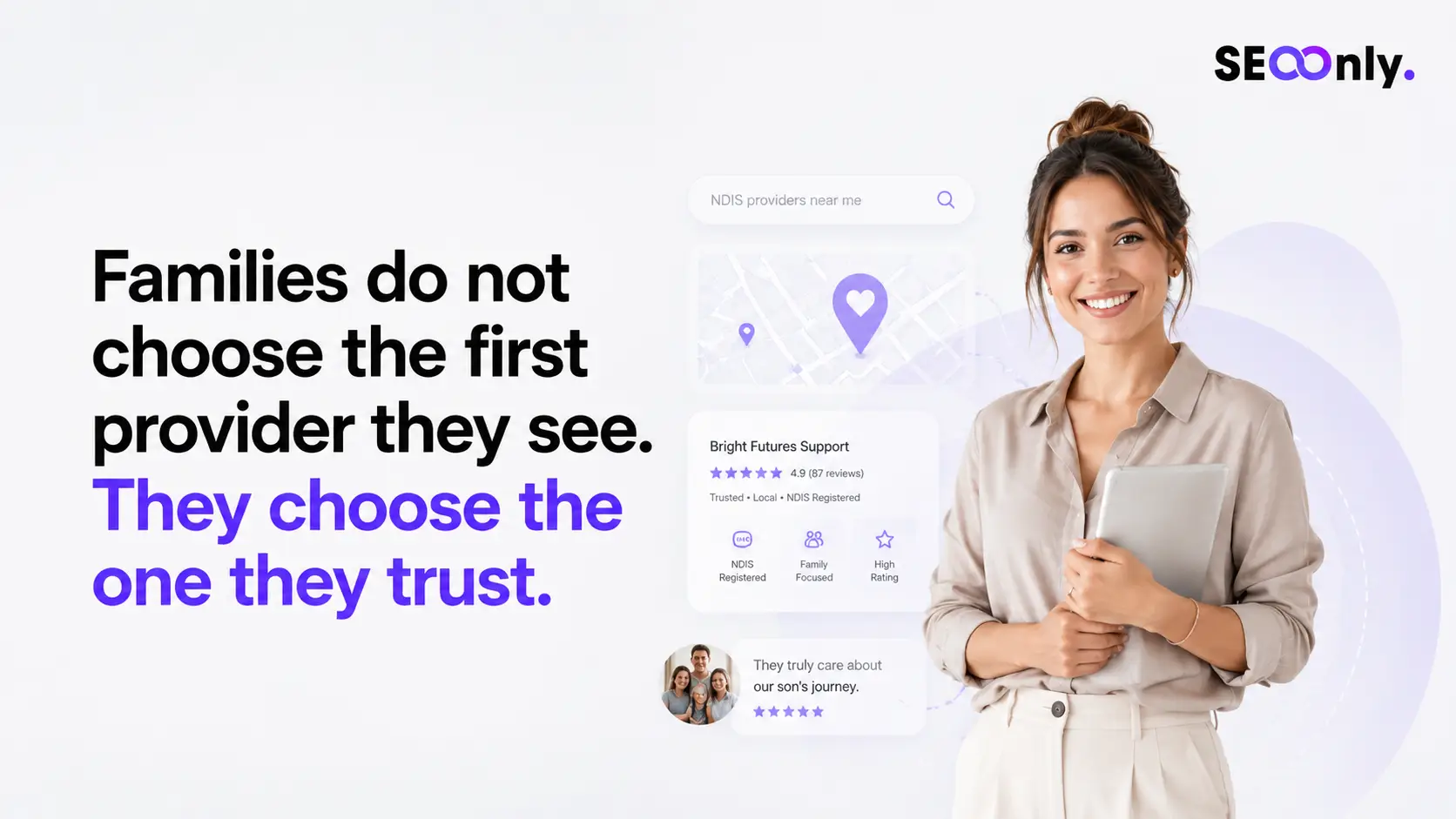
An NDIS family is nervous, and rightly so. Before they contact you, they want to know you are real, safe and experienced with people like them. So they read. They look for whether you are registered or clear about being unregistered. They look for the supports you actually provide. They look for signs a real, caring team is behind the website.
Do not assume a slick homepage does this. It does not. What does it is plain, honest information: who you are, what you offer, which areas you cover, and reassurance that you understand their situation. A family reading your page is quietly asking one question the whole time. Can I trust these people with my son, my daughter, myself? Your website has to answer yes without them having to ring to find out.
Step three: they read reviews and ask their community
NDIS families talk to each other. Facebook groups, local networks, word of mouth at the school gate. But they also read reviews online, the same as everyone else.
BrightLocal’s 2025 review survey found 84% of people use Google to read business reviews. For a provider, a handful of genuine reviews from other families does more than any amount of marketing copy, because it is other families saying you are safe and good. Most providers never think to ask for one. That is a gap you can close this month.
Step four: some now ask AI first
Here is the newer part of the journey. A growing number of people open ChatGPT or read Google’s AI summary before they visit any website at all.
ChatGPT reached 900 million weekly users by late February 2026, reported by TechCrunch. BrightLocal found 8% of people now begin a local search with an AI tool, and 31% use AI at least monthly for a local recommendation. An overwhelmed parent typing “how do I find a good NDIS occupational therapist near me” into ChatGPT is a very real 2026 search.
But here is the reassuring part. People do not blindly trust the machine. BrightLocal found only 18% felt ready to contact a business straight off an AI suggestion, and 43% of those who started with AI then went to Google to check. For a decision as personal as disability support, that double checking is even more likely. So you need both: to be named by the AI, and to look trustworthy when the family verifies you.
What the whole journey means for your website
Put those steps together and a pattern appears. Families do not decide in one click. They search, they read, they check reviews, they verify, and only then do they reach out. BrightLocal found 75% of people use more than one channel before choosing. Your job is to be steady and reassuring at every stop.
That comes down to a few things:
- Load fast and read cleanly on a phone. That is where the journey starts, usually after hours.
- Say plainly who you are, what you offer and where. Registration status, supports, service areas, and a human tone that shows you understand.
- Make contact effortless. A phone number and a simple enquiry form, visible without hunting, on every page.
- Gather genuine reviews. A few honest words from other families outweigh any slogan.
- Write in plain language. Both anxious parents and the AI tools reward clear, jargon-free answers to real questions.
Picture a plan manager in Geelong whose site loads instantly, explains in plain words exactly how they help, shows a few warm reviews from local families, and has a contact button right there on the screen. Now picture a competitor with a prettier site that makes a tired parent dig for basic answers. Same suburb, same participants searching. Only one of them gets the enquiry. And it is not the prettier one. It is the one that understood the journey.
Want to know if families searching in your area are finding you, or your competitor?
Get a complimentary SEO review from SEOOnly. No hard sell. No pressure. Get in touch.
Sources
- NDIS Quarterly Report (31 March 2025): ndis.gov.au
- BrightLocal, Consumer Search Behavior research (US, 2026): brightlocal.com
- BrightLocal, Local Consumer Review Survey (2025): brightlocal.com
- TechCrunch, “ChatGPT reaches 900M weekly active users” (Feb 2026): techcrunch.com
Related services
How SEOOnly can help
About the author
Vicky Miller
Head of SEO at SEOOnly
Vicky heads SEO at SEOOnly, helping businesses worldwide turn search visibility into measurable growth across Google and AI search. He writes on technical SEO, content strategy, and the shift to answer engines.
LinkedInLast updated September 8, 2026