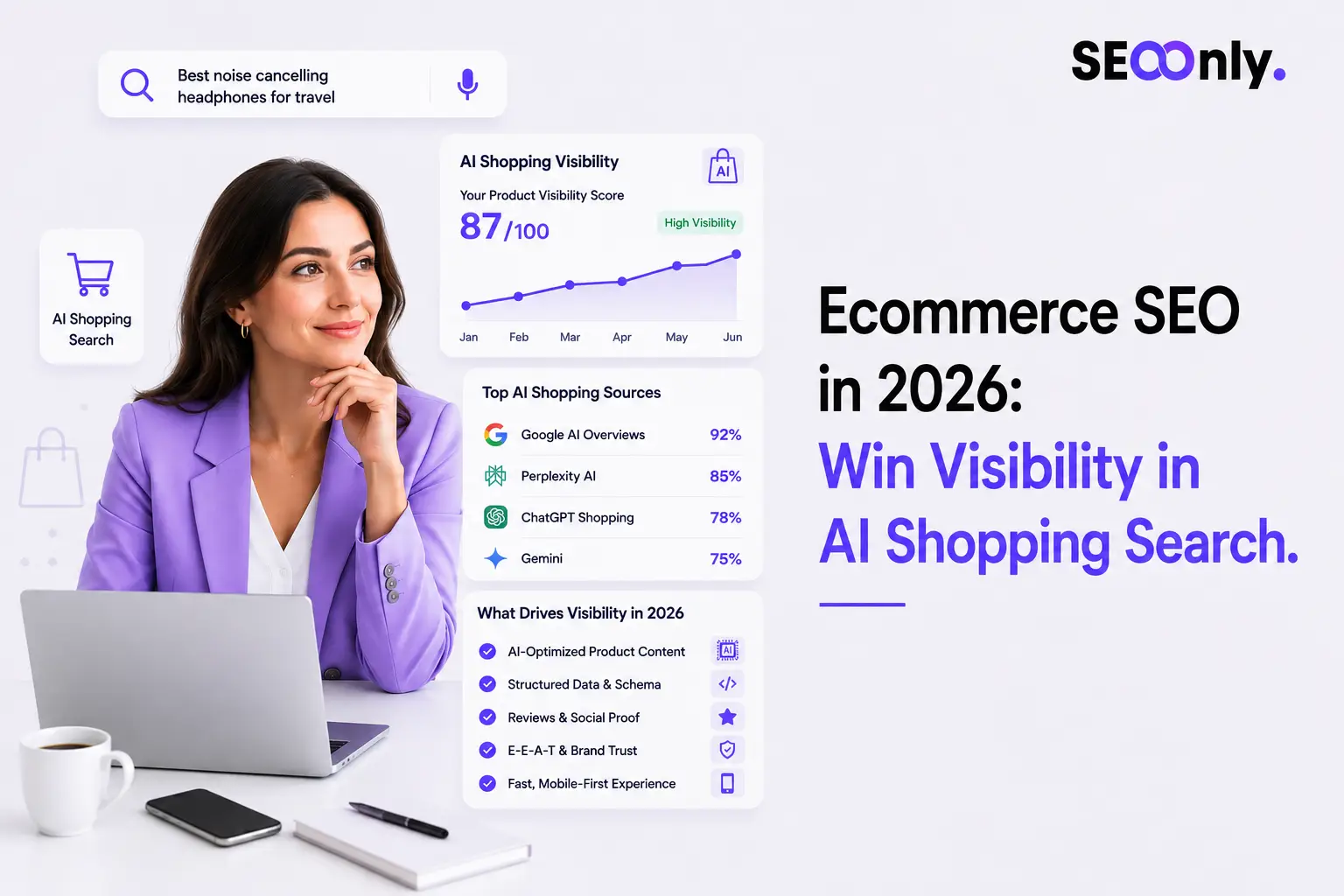
Ecommerce SEO in 2026: Winning Product Visibility in AI Shopping Search
Let me ask you something. When a customer decides they want the thing you sell, where do they actually start?
For a long time the answer was Google. They typed in “best running shoes for flat feet”, scrolled a bit, and clicked. If your store ranked, you got the visit. Simple.
That is quietly changing. More and more people are not searching at all. They open ChatGPT and just ask. “What is a good waterproof jacket for hiking in Tasmania under two hundred dollars?” And they take the shortlist it gives them.
Here is the uncomfortable part. If your product is not in that shortlist, the shopper never sees it. Not on page two. Nowhere.

This is not a niche behaviour anymore
The market is enormous, and it is online. The Australia Post eCommerce Report 2025 found Australians spent $82.6 billion online in 2025, up 14% on the year before. Online now makes up 24% of all retail spending. Some 9.8 million households shopped online, which is more than eight in ten Australian households. This is not a fringe channel. This is where the country shops.
Now layer the AI shift on top. ChatGPT reached 800 million people using it every week by October 2025, and 900 million by late February 2026 (reported by TechCrunch, using OpenAI’s own figures). A good chunk of those people are asking it what to buy.
BrightLocal’s 2026 research backs this up. It found 31% of people now use an AI tool at least once a month to get a recommendation, and 8% start their search with AI rather than a search box. That share is only heading one way, and it is worth remembering how much shopping already happens online. The Australia Post report found around 41% of shoppers buy online at least fortnightly. These are habits, not one-off purchases.
So the old goal of “rank number one for my keyword” is no longer the whole game. The new goal is to be the product the AI names when it answers, and to still look trustworthy when the shopper goes off to double-check you.
Why AI answers change the maths
Here is the thing about an AI answer. It does not hand the shopper ten blue links to choose from. It gives them a tidy list of two or three options, and often a reason for each one.
We have already seen this pattern in regular search. A study in the United States by the Pew Research Center found that when Google shows an AI-written summary at the top, people click through to an actual website only 8% of the time, compared with 15% when there is no summary. Almost half the clicks, gone.
For an online store that is both a threat and an opportunity. The threat is obvious. Fewer clicks means less traffic to fight over. The opportunity is that if you are one of the few products named in the answer, you get a warm, pre-qualified shopper who has already been told you are a good fit.
Do not assume this is about gaming the robot. The AI tools pull from the same signals that already make a product look trustworthy. Your job is to make those signals clear, complete, and consistent.
What actually gets a product named
The good news is that this is not mysterious, and most of it is within your control today.
- Product pages that answer real questions. Not just a photo and a price. What is it made of, who is it for, what size should I get, how does it wash, will it fit my situation. When your page answers the questions a shopper would ask, the AI can quote you with confidence. A thin page gives it nothing to work with.
- Genuine, recent reviews. Ratings and written reviews are one of the strongest trust signals there is, and the AI tools read them. A steady trickle of fresh reviews tells everyone that real people buy this and are happy. Most stores simply never ask.
- Clear, structured details. Price, availability, brand, specifications, and options laid out plainly. Structured data is a bit of code that labels what is on your page so machines understand it. Get that right and both Google and the AI tools can read your product properly.
- Honest, specific descriptions. Write the way your customer speaks. “Warm enough for a Hobart winter” beats “premium thermal outerwear” every time, because it answers a real question the shopper has.
- Consistent details everywhere. If the price, the name, or the specs differ between your site, your listings, and your marketplace pages, you confuse the very systems you want to impress. Keep the story the same wherever your product appears.
A quick example
Picture two online stores selling much the same camping gear.
Store A has clean photos and a short one-line description on each product. No reviews. No detail on weight, pack size, or what weather the gear suits.
Store B lists the weight, the pack size, the temperature rating, has forty recent reviews, and a description that says “tested on the overland track in Tasmania”.
Now ask an AI for “a lightweight tent for a first hiking trip”. For Store A there is almost nothing to go on. For Store B, everything the AI needs to recommend it with confidence is right there. Same products. Completely different visibility. And none of it was luck.

What this means for your store
Shopping has quietly split into two crowds. Plenty of customers still search and scroll the old way. A rising number just ask an AI and act on the shortlist. You cannot pick which crowd your next customer belongs to, so you have to show up for both.
That means product pages written for real people, a habit of collecting reviews, and clean details that machines can read. This is what AI-Powered SEO looks like for an online store. Not clever tricks. Just the right signals, done consistently across your catalogue.
The stores treating this as normal work, rather than a job for “someday”, are the ones being named in those answers right now. Most of your competitors have not started yet. That is exactly why it is worth starting today.
Want to know whether AI is recommending your products, or the store down the road?
Get a complimentary AI visibility check from SEOOnly. No hard sell. No pressure. Get in touch.
Sources
- Australia Post eCommerce Report 2025: auspost.com.au
- TechCrunch, “ChatGPT reaches 900M weekly active users” (Feb 2026): techcrunch.com
- BrightLocal, Consumer Search Behavior research (US, 2026): brightlocal.com
- Pew Research Center, “Google users are less likely to click on links when an AI summary appears” (US, Jul 2025): pewresearch.org
Related services
How SEOOnly can help
About the author
Vicky Miller
Head of SEO at SEOOnly
Vicky heads SEO at SEOOnly, helping businesses worldwide turn search visibility into measurable growth across Google and AI search. He writes on technical SEO, content strategy, and the shift to answer engines.
LinkedInLast updated September 25, 2026