
Why Your Product Pages Aren’t Ranking (Even With Good Reviews)
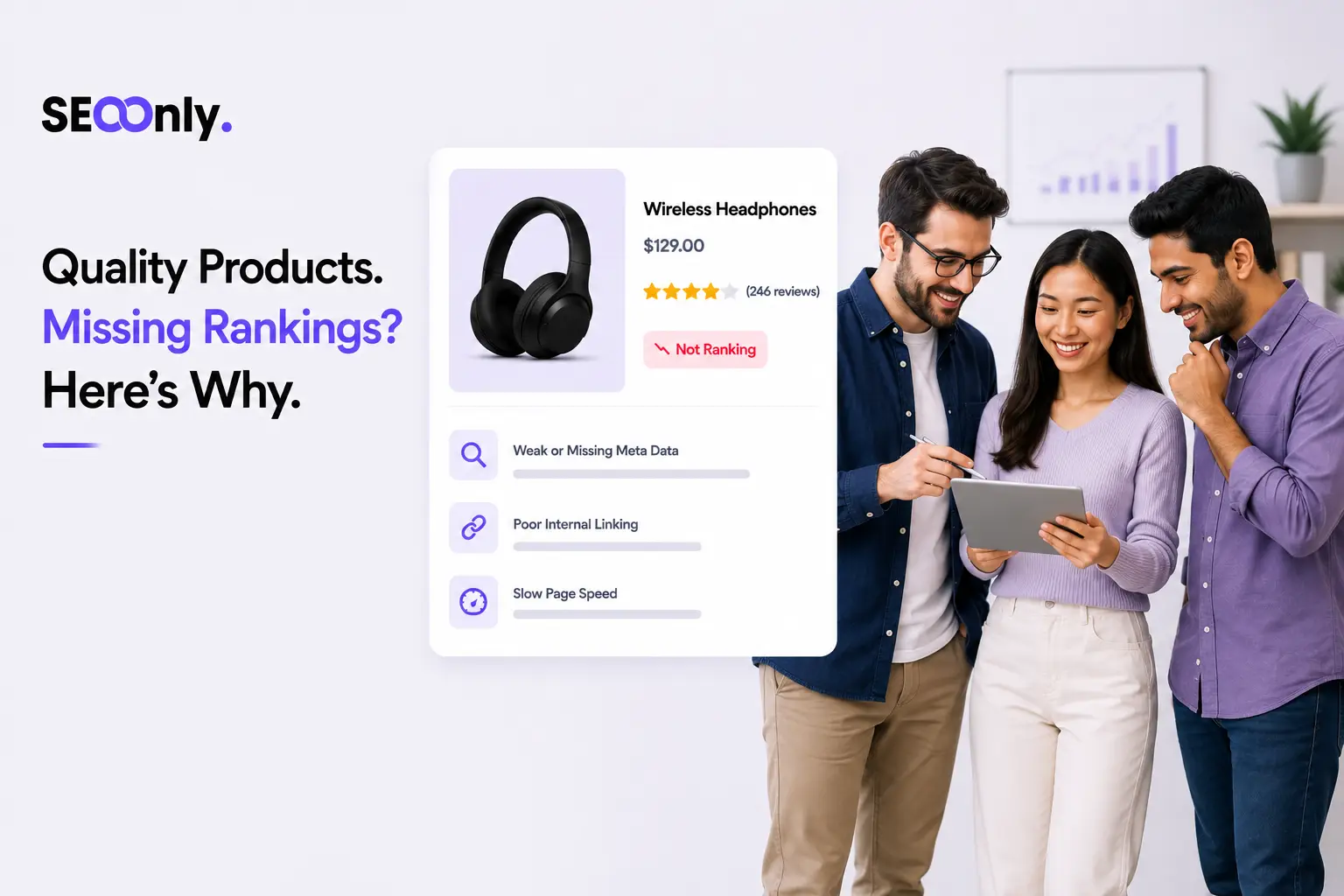
Let me be direct. You have a product people love. Four and a half stars, dozens of happy reviews, repeat buyers. And yet when you search for what you sell, your page is nowhere near the top.
It is one of the most frustrating things in ecommerce. Good product, good reviews, no visibility.
Here is the thing. Reviews are powerful, but they are only one piece. Ranking a product page is about a lot of small signals working together. When one or two are broken, the whole page struggles, no matter how good the reviews are.
Let us walk through the real reasons, and what to do about each.
1. The page is too thin for Google to trust
A photo, a price, and one line of description is not a page Google wants to rank. It is a stub.
This matters more than most owners realise. An Ahrefs study of around 14 billion pages found that 96.55% of all pages get zero traffic from Google. Zero. A big reason is that most pages simply do not give search engines enough to work with.
The fix is not to pad it with waffle. It is to answer the questions a buyer would actually ask. What is it made of. Who is it for. What size should I get. How do I care for it. What makes it different from the cheaper one next to it. Answer those honestly and your page suddenly has real substance.
2. Your reviews are trapped where Google cannot use them
This one catches a lot of stores. Your reviews might look great on the page, but they are loaded in a way that search engines and AI tools cannot read.
Reviews only help your ranking when they are marked up properly. That means structured data, which is a bit of code that labels what is on your page so machines understand it. Done right, it tells Google “this product has 47 reviews and a 4.6 average”. Done wrong, or not at all, and all that goodwill is invisible to the very systems you want to impress.
If your reviews live only inside a third-party widget that Google cannot see, you are getting the trust benefit with customers but none of the search benefit. Worth checking.
3. Ten pages are competing with each other
Here is a quiet killer. The same product exists on your site at several web addresses. One for each colour. One from an old campaign. One the platform generated automatically.
Google looks at all of them and cannot tell which is the real one. So instead of one strong page, you have five weak ones splitting the votes between them.
The fix is a canonical tag, which is a tag that tells Google which version of a page is the main one. Point all the duplicates at the single page you actually want to rank, and let that page collect all the credit.

4. The page is too slow, especially on a phone
Most of your shoppers are on their phones. If your product page takes an age to load, you lose them before they even see the reviews, and Google notices the frustration.
Speed is not a small thing. A study by Deloitte and Google called “Milliseconds Make Millions” looked at 37 brand sites and more than 30 million sessions. It found that improving mobile load time by just 0.1 of a second lifted retail conversions by 8.4% and average order value by 9.2%. A tenth of a second. That is how much speed matters to real revenue.
Big unoptimised images are the usual culprit on product pages. A single unedited photo straight off a phone can be several megabytes. Compress your images, and you often fix the problem in an afternoon without touching anything else.
5. The title says nothing a shopper would search
Picture a homewares store in Adelaide with a product simply titled “The Marlowe”. Lovely name. But nobody searches “The Marlowe”. They search “linen bedspread queen”.
If your page titles are clever brand names with no plain description, Google has nothing to match a real search against. Add what the thing actually is. “The Marlowe Linen Bedspread, Queen” gives Google, and the shopper, something to grab onto.
6. Nothing links to the page
A product page floating on its own, with no links pointing to it from your category pages, blog posts, or related products, looks unimportant to Google. Links are how search engines understand what matters on your site.
Make sure your best products are linked from your main category pages and, where it fits, from helpful content. A page about “how to choose a hiking tent” that links to the tents you sell does two jobs at once. It helps the shopper decide, and it tells Google those product pages matter.
The bigger picture
Do not assume good reviews alone will carry a page to the top. They are a genuine asset, and in the age of AI shopping they matter more than ever. But they work alongside the basics, not instead of them.
And the basics are worth getting right, because the market is real. The Australia Post eCommerce Report 2025 found Australians spent $82.6 billion online in 2025, with online now making up 24% of all retail spending. Some 9.8 million households, more than eight in ten in the country, shopped online. That is a lot of buyers looking for exactly what you sell. The question is whether your page is set up to be found by them.
Think of your product page as a shopfront. The reviews are the friendly staff inside. But if the door is jammed, the sign is blank, and the window is too slow to load, nobody gets far enough in to meet them.
Fix the page around the reviews, and the reviews finally get to do their job. This is what AI-Powered SEO looks like in practice for an online store. Not one clever trick, but a handful of unglamorous fixes that add up to real visibility.
Great reviews but pages that still won’t rank? Let us find out why.
Get a complimentary SEO review of your store from SEOOnly. No hard sell. No pressure. Get in touch.
Sources
- Ahrefs, “How Many Websites Get Traffic From Google?” study (2023): ahrefs.com
- Deloitte and Google, “Milliseconds Make Millions” (2020): web.dev
- Australia Post eCommerce Report 2025: auspost.com.au
Related services
How SEOOnly can help
About the author
Vicky Miller
Head of SEO at SEOOnly
Vicky heads SEO at SEOOnly, helping businesses worldwide turn search visibility into measurable growth across Google and AI search. He writes on technical SEO, content strategy, and the shift to answer engines.
LinkedInLast updated September 21, 2026