ChatGPT vs Google: Where Australians Are Actually Searching in 2026
Let me ask you something. When you need to find a business you have never used before, where do you go first now?
For most of us it was Google, on autopilot, for twenty years. But something has shifted. Half the country seems to be “just asking ChatGPT” for everything from recipes to which tradie to call.
So which one wins? Is Google finished? Should you drop everything and chase ChatGPT? Let us settle it with the actual numbers, because the truth is more useful than either extreme.
ChatGPT is genuinely huge
First, let us not pretend this is a fad.
ChatGPT reached 800 million people using it every week by October 2025. By late February 2026 that figure was 900 million, reported by TechCrunch using OpenAI’s own numbers. A hundred million more weekly users in about four months.
That is not a corner of the internet. That is a mainstream habit, the kind of scale that used to belong to Google alone. When a tool gets that big, your customers are using it, whether or not it feels that way from behind your counter.
So anyone telling you ChatGPT does not matter for finding businesses is not looking at the size of the thing.
But Google has not gone anywhere
Now the other side, because the “Google is dead” crowd is just as wrong.
BrightLocal’s 2026 research on how people search for local businesses is the clearest picture we have. It found that 84 per cent of consumers had looked up a local business online in the last three months. Of those, 52 per cent started on Google Search, and 71 per cent used Google at some point in the process.
And AI? Only 8 per cent started their search with an AI tool. A meaningful slice, growing, but nowhere near a takeover. Google is still very much the front door for finding a local business.
So the honest scoreboard, for finding a business right now, is not close. Google leads. ChatGPT is rising fast and cannot be ignored. Both statements are true at once.
The real answer: it is not either-or
Here is the thing everyone misses when they frame it as a fight. People do not pick one tool and stick to it. They use several, in one go.
That same BrightLocal research found 75 per cent of people used more than one channel before deciding on a business. And look at what AI users do specifically: 43 per cent of the people who started with AI then went to Google to check the business out. Only 18 per cent felt ready to contact a business straight off an AI recommendation.
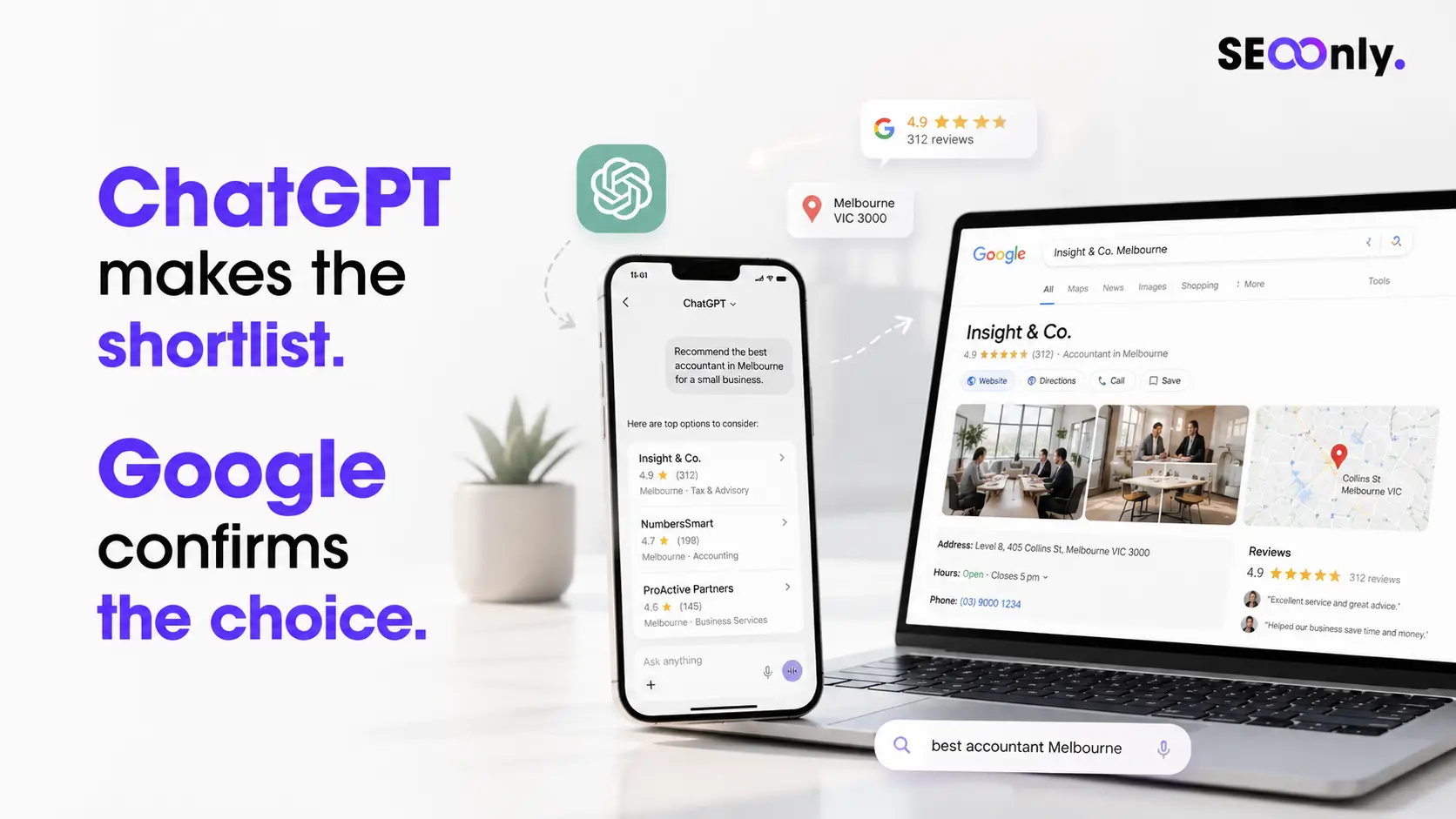
So the modern search is a relay, not a race. Someone asks ChatGPT “who does good bathroom renos in Hobart”, gets three names, then opens Google to read reviews and look at photos before ringing anyone. ChatGPT made the shortlist. Google confirmed the choice.
Do not assume it is one or the other. For most real decisions, it is both, in sequence.
Why this changes what you actually do
If it were a simple contest, your job would be simple too: back the winner. Because it is a relay, you have to be ready at every handover.
Picture a mobile mechanic in Geelong. To win the modern customer, he needs three things to line up:
- Get named when someone asks the AI. When a person asks ChatGPT for a good mechanic nearby, the tools pull from clear, consistent information about your business. If that information is thin or contradictory, you are invisible at step one.
- Hold up when they cross-check on Google. This is where that free Google panel with your hours, reviews and phone number earns its keep. It is the first thing people see when they verify an AI suggestion.
- Answer the real questions on your site. Prices, areas covered, how to book, what to expect. When your pages answer plainly, both the AI quoting you and the human reading you get what they need.
Notice that none of this asks you to choose ChatGPT over Google. The same clean, trustworthy foundation feeds both. That is the whole trick.
Why the “one or the other” thinking costs you
When owners frame it as a bet, they usually pour everything into one tool and quietly neglect the other. That is where the money leaks out.
Back the AI too hard, and you win the shortlist but fall over on the cross-check, because your Google listing is out of date and your reviews are stale. Back Google too hard, and you never get named in the AI answer in the first place, so you are not even on the shortlist to verify. Either way you lose the customer somewhere in the middle of their journey, and you never see where.
The businesses that win treat both as one connected job. They know a person might arrive from either direction, and often both, so they make sure every handover is covered.
What most business owners get wrong
The real problem is that owners treat this like a bet. They ask “should I focus on Google or AI”, as if picking correctly is the win.
It is the wrong question. The customer is not loyal to a platform. They are loyal to getting a good, quick, trustworthy answer, and they will hop between tools to get it. Your competitor is not winning because they chose the right box. They are winning because their information is so clear and consistent that every tool, and every person, can find and trust it.
Here is a simpler way to think about it. Google versus ChatGPT is the wrong framing. It is you versus invisible. If your business is easy to find and easy to trust, you show up wherever the customer happens to be looking. If it is not, it barely matters which tool they picked.
The bottom line for 2026
Google is still the biggest front door for finding a local business, by a wide margin. ChatGPT is a genuine, fast-growing second one, and people move between them freely before they decide.
So stop asking which one to chase. Build the foundation that works for both: a spotless, accurate presence, a habit of collecting reviews, and a website that answers real questions in plain words. That is what AI-Powered SEO looks like in practice, and it is the only answer that holds up no matter where search goes next.
The businesses doing this are being found on both. Most of their rivals are still arguing about which one matters.
Want to see whether you show up on Google and in AI answers, or neither?
Get a complimentary AI visibility check from SEOOnly. No hard sell. No pressure. Get in touch.
Sources
- TechCrunch, “ChatGPT reaches 900M weekly active users” (Feb 2026): techcrunch.com
- BrightLocal, Consumer Search Behavior research (US, 2026): brightlocal.com
Related services
How SEOOnly can help
About the author
Vicky Miller
Head of SEO at SEOOnly
Vicky heads SEO at SEOOnly, helping businesses worldwide turn search visibility into measurable growth across Google and AI search. He writes on technical SEO, content strategy, and the shift to answer engines.
LinkedInLast updated September 8, 2026