AI Overviews Are Here: What the Data Says About Clicks, Traffic and Visibility
Here is something most business owners have noticed but not named.
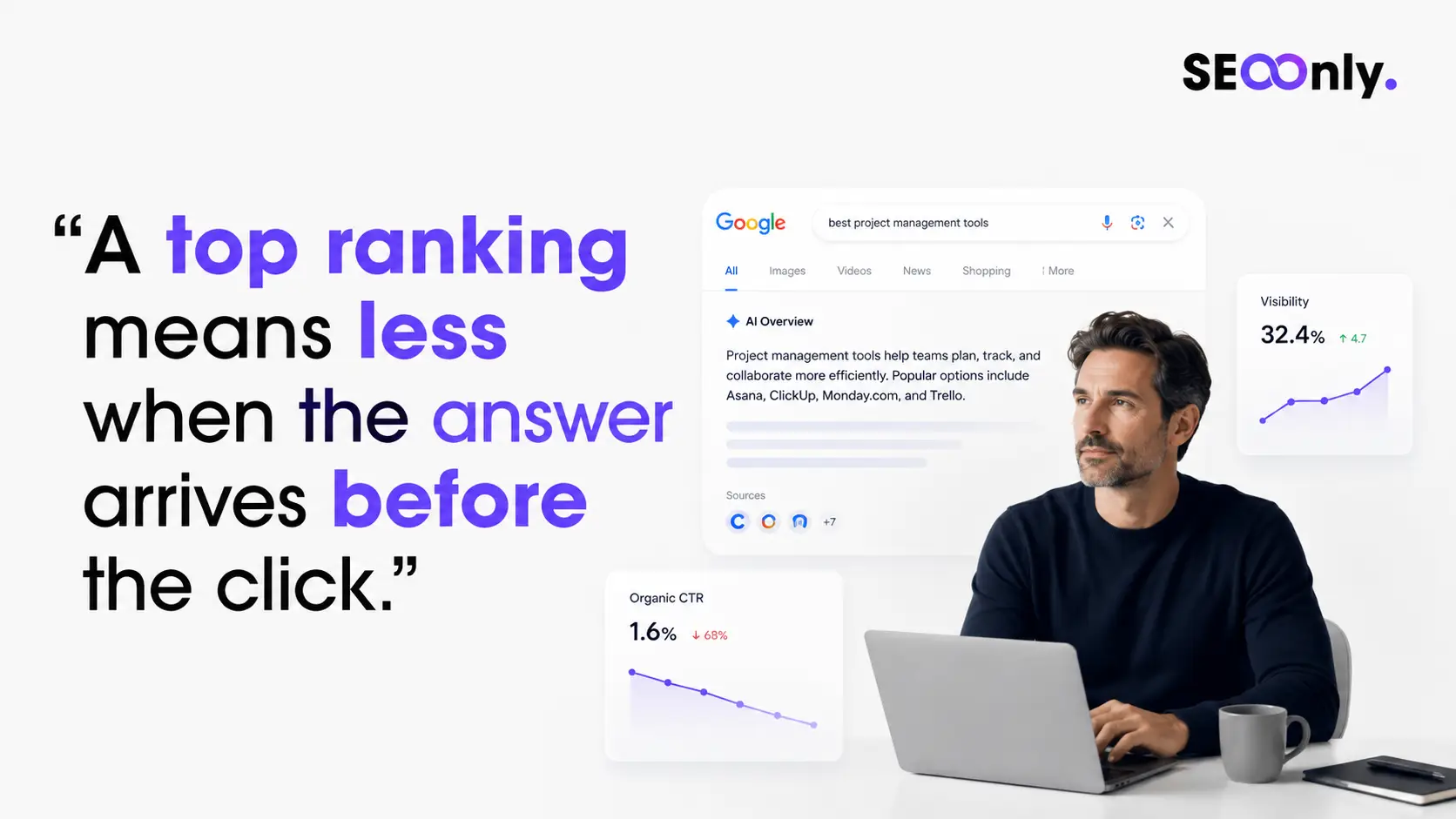
You search for something on Google, and before any website shows up, there is a paragraph written by AI answering your question. No blue links to click. Just the answer, sitting right at the top.
That block has a name. Google calls it an AI Overview. And it is quietly rewriting what a top ranking is actually worth. Let us look at what the data says, without the panic and without the hype.
What an AI Overview actually is
In plain terms, an AI Overview is Google reading a handful of websites, then writing you a summary answer in its own words. It might name a few sources. It might not send you to any of them.
So the moment a search shows one, the game changes. The question is no longer only “am I the top result”. It is “did the AI use my information, and did the person still need to click anyone at all”.
You do not have to guess how common these are. In the Pew Research Center’s US study, about one in five Google searches, 18 per cent, produced an AI summary. That is a big slice, and it is growing.
What happens to your clicks
This is the number that gets everyone’s attention, and rightly so.
The Pew Research Center in the United States measured what people do when an AI summary appears. When there is a summary, users click through to a website only 8 per cent of the time. When there is no summary, they click 15 per cent of the time. That is close to half the clicks disappearing the moment the AI answer shows up.
And the link inside the summary? Only 1 per cent of people clicked it. The AI does the talking, and the sources sit there unread.
Pew found one more thing worth knowing. People were more likely to end their whole browsing session on a page that had an AI summary, 26 per cent, than on a page without one, 16 per cent. The summary answers the question, and the search is over.
This is US data, so read it as the direction of travel rather than the exact Australian figure. But the tool is the same one appearing above your business in Google right now.
The click was already leaking
Before you decide AI Overviews broke search, remember that clicks were already draining away.
The SparkToro 2024 zero-click study, by Rand Fishkin, found that for every 1,000 Google searches in the US, only about 360 clicks reach the open web. More than half of US Google searches, 58.5 per cent, end without a single click.
So the honest picture is this. AI Overviews did not invent the zero-click search. They made a very large existing problem more visible, and a bit worse, by answering more questions on the page itself.
Why visibility still matters, even without the click
Here is where owners get gloomy and stop reading. Do not. Because a missing click is not the same as a missing customer.
Think about how people actually behave. BrightLocal’s 2026 research found that only 18 per cent felt ready to contact a business straight off an AI recommendation, and 43 per cent of those who started with AI then went to Google to check the business. On top of that, 75 per cent used more than one channel before deciding.
So being named in the AI answer is not the finish line. It is the introduction. If the Overview mentions your business, or the searcher sees your name and reputation while forming a shortlist, you are in the running even on a search that produced no click. Visibility is doing work that a raw traffic number will never show you.
Picture a landscaper in Toowoomba. The AI summary answers “what does a new backyard cost” without sending anyone to a website. But it lists a few local names, and one of them is his. He got no click and plenty of value, because the next thing that person does is search his name and read his reviews.
How to get used by AI Overviews, not buried by them
The businesses that AI tends to quote are not doing anything exotic. They are being clear, and they are being trusted. Here is what that looks like in practice.
- Answer the actual question, plainly, near the top of the page. AI Overviews pull from pages that give a clean, direct answer. A page that waffles for four paragraphs before getting to the point gives the machine nothing to lift.
- Keep your Google Business Profile accurate. That free Google panel with your hours, reviews and phone number is one of the most trusted signals there is. When it matches your website exactly, both Google and the AI treat you as reliable.
- Collect recent reviews. Reputation is what people check the moment they leave the AI answer. A steady trickle of fresh reviews wins the second look.
- Write for how people ask. Real questions, in real words. “How long does bathroom waterproofing take in Perth” beats a vague services heading every time.
Stop measuring the wrong thing
The real problem with AI Overviews is not that they exist. It is that most owners are still watching one number, clicks to the website, and panicking when it dips.
Clicks are only one way you show up now. Being named in the answer, being the business people search by name afterwards, being the one whose reviews reassure a wavering customer: none of that lands neatly in an old traffic report, and all of it brings you work.
Do not assume falling clicks means falling business. Sometimes it means your information is doing its job before the click ever happens. This is what AI-Powered SEO is built for: being the answer, not just a link on page one.
The owners who understand that shift are already being cited in these summaries. Most of their competitors are still refreshing their traffic dashboard and wondering what went wrong.
Not sure whether AI Overviews are naming your business or skipping past it?
Get a complimentary AI visibility check from SEOOnly. No hard sell. No pressure. Get in touch.
Sources
- Pew Research Center, “Google users are less likely to click on links when an AI summary appears” (US, Jul 2025): pewresearch.org
- SparkToro, 2024 Zero-Click Search Study (US, Jul 2024): sparktoro.com
- BrightLocal, Consumer Search Behavior research (US, 2026): brightlocal.com
Related services
How SEOOnly can help
About the author
Vicky Miller
Head of SEO at SEOOnly
Vicky heads SEO at SEOOnly, helping businesses worldwide turn search visibility into measurable growth across Google and AI search. He writes on technical SEO, content strategy, and the shift to answer engines.
LinkedInLast updated September 8, 2026