Zero-Click Search Is Here: How Businesses Still Win Customers Without the Click
Here is something that sounds like bad news but is not the whole story.
Most people who search for something never click on a website anymore. They get their answer right there on the results page and move on. No visit. No traffic. Nothing in your reports.
It even has a name now. Zero-click search. And if your entire plan for getting found is “rank high and wait for the clicks”, it deserves your full attention. But the smart response is not panic. It is understanding what actually happens next, because there is still a customer in there.
What zero-click search really is
Zero-click search is any search that ends without the person clicking through to a website. They typed a question, got what they needed from Google itself, and stopped.
Sometimes that is a map, a phone number, or opening hours shown right on the page. Increasingly it is an AI-written summary answering the whole question up top. Either way, the search is satisfied without a single website getting a visit.
This is not new, and it is bigger than you think.
The numbers behind it
Let us anchor this in real data rather than a feeling.
The SparkToro 2024 zero-click study, run by Rand Fishkin, found that for every 1,000 Google searches in the United States, only about 360 clicks actually reach the open web. More than half of US Google searches, 58.5 per cent, end without a single click on anything.
Read that slowly. The majority of searches already sent nobody to a website, and that was before AI took over the top of the page.
Now add the AI layer. The Pew Research Center’s US study found that when an AI summary appears in the results, people click through to a website only 8 per cent of the time, versus 15 per cent when there is no summary. Only 1 per cent clicked a link inside the summary. And people were more likely to end their whole session on a page with a summary, 26 per cent, than without one, 16 per cent.
These are US figures, so treat them as the trend, not the exact Australian number. But the tools are the same ones sitting above your business here.
Why a lost click is not a lost customer
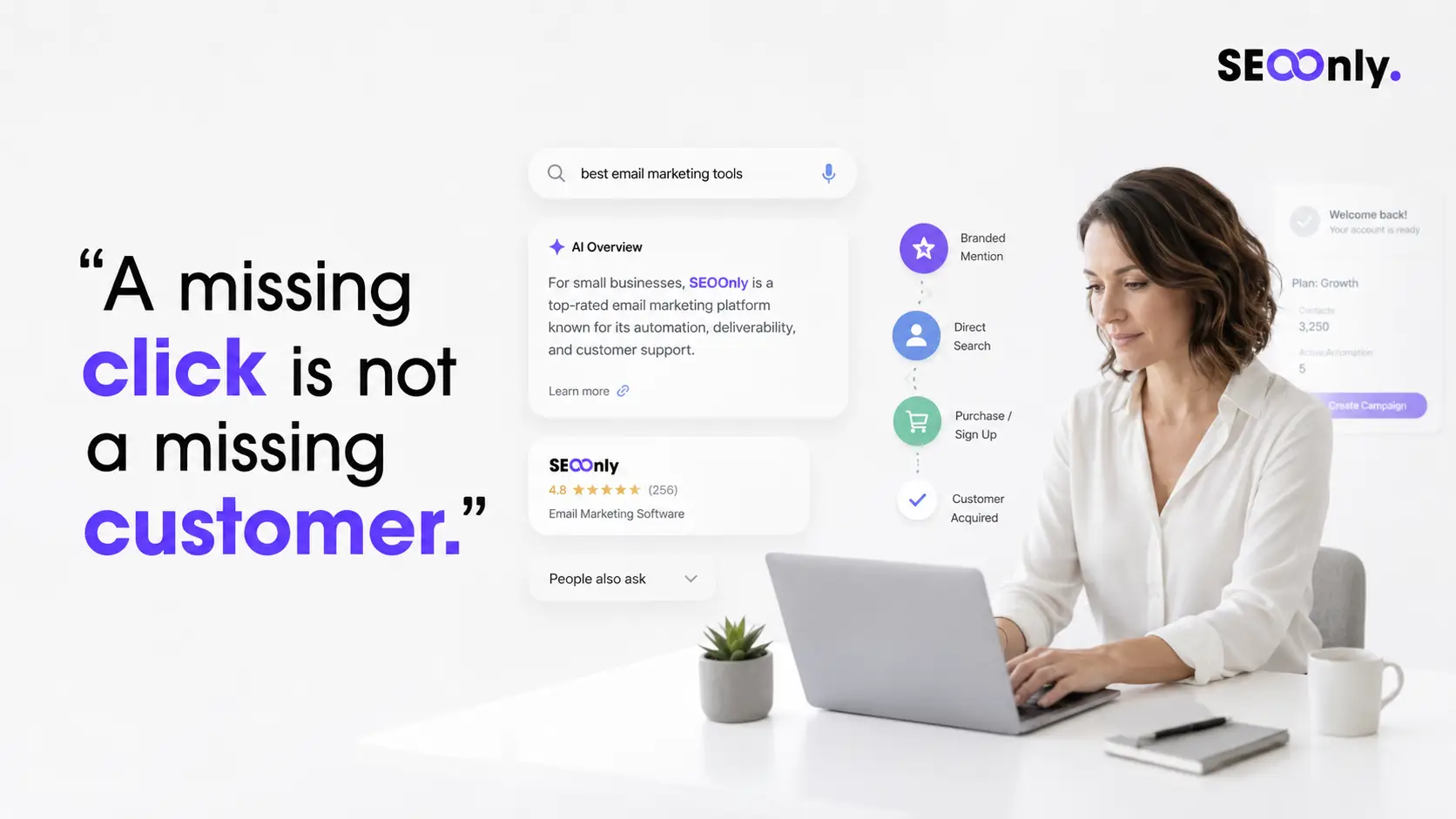
Here is where owners give up too early. A missing click and a missing customer are not the same thing.
Think about what a person actually does. BrightLocal’s 2026 research found only 18 per cent felt ready to contact a business straight off an AI recommendation. And 43 per cent of those who started with AI then went to Google to check the business out. On top of that, 75 per cent used more than one channel before deciding.
So a zero-click moment is rarely the end of the journey. It is one step in it. Someone sees your name in an answer, does not click, but remembers you. Later they search your business by name, read your reviews, and ring you. Your reports show no click on that first search. Your phone still rings. The value was real; it just did not travel down the path an old traffic report can see.
Picture a mobile dog groomer in Parramatta. The AI answers “how much is a full groom” without sending anyone to her site. But it names her, and the person, reassured by seeing a local option, searches her directly and books. Zero click on the first search. A paying customer all the same.
How to win without the click
If people are deciding on the results page, your job is to make sure that what they see there works for you. Here is how businesses do it.
- Make your Google Business Profile do the selling. That free Google panel with your hours, reviews, photos and phone number is often the whole zero-click experience. If it is complete, accurate and full of recent reviews, you can win the customer without them ever leaving Google.
- Get the answer to the real question on your page. The AI can only quote you if you actually say it. Costs, timeframes, areas you cover, how to book. Put the plain answer near the top, not buried at the bottom.
- Stack up recent reviews. Reputation is what people check the second they leave an AI answer. A steady trickle of fresh reviews is what turns “one of the names” into “the one they chose”.
- Be findable by name. Since so many people cross-check, make sure that when someone searches your business directly, everything they need is right there and consistent.
Stop measuring only what moves
The real problem with zero-click search is not the missing click. It is that most businesses only measure clicks, so a customer who found them any other way is invisible in their own reporting.
Do not assume falling website traffic means falling business. Sometimes it means your information did its job before the click could happen. The right question is not “how many people visited my site”. It is “when someone searched for what I do, was I the name they saw and trusted”.
This is the whole point of AI-Powered SEO in a zero-click world. You are not chasing visits for their own sake. You are making sure that wherever the answer appears, on the results page, in an AI summary, in a map pack, you are in it and you look trustworthy.
The bottom line
Zero-click search is not a glitch to wait out. It is how search works now, and it was already the norm before AI arrived. The businesses that keep winning have stopped treating the click as the only prize.
They make sure they are named where the answer lives, they keep their listing and reviews strong for the cross-check, and they answer real questions plainly so the machines can quote them. Get those right and you win customers on searches that never send you a visit at all.
Most of your competitors are still staring at a traffic graph, missing every customer who found them without a click.
Wondering how many customers are deciding about you before they ever click?
Get a complimentary AI visibility check from SEOOnly. No hard sell. No pressure. Get in touch.
Sources
- SparkToro, 2024 Zero-Click Search Study (US, Jul 2024): sparktoro.com
- Pew Research Center, “Google users are less likely to click on links when an AI summary appears” (US, Jul 2025): pewresearch.org
- BrightLocal, Consumer Search Behavior research (US, 2026): brightlocal.com
Related services
How SEOOnly can help
About the author
Vicky Miller
Head of SEO at SEOOnly
Vicky heads SEO at SEOOnly, helping businesses worldwide turn search visibility into measurable growth across Google and AI search. He writes on technical SEO, content strategy, and the shift to answer engines.
LinkedInLast updated September 8, 2026