Why “SEO Is Dead” Is Wrong (And What Has Actually Changed)
You have heard it before. “SEO is dead.” Someone says it every single year, usually right before they try to sell you something else.
Let me be direct. It is not dead. Not close.
What is true is that SEO has changed more in the last two years than in the ten before it. The people declaring it dead are really just describing the bit that changed, and pretending the whole thing fell over. So let us sort the noise from the truth, because getting this wrong costs Australian businesses real money.
Where the “SEO is dead” idea comes from
The panic has one main source. AI answers.
You have seen it. That AI-written summary sitting at the top of Google, answering the question before any website gets a look in. And more people asking ChatGPT things they used to type into a search box. ChatGPT reached 900 million people using it every week by late February 2026, up from 800 million just months earlier.
Here is the data that spooks people. In a United States study by the Pew Research Center, when that AI summary appeared, people clicked through to an actual website only 8% of the time, compared with 15% when there was no summary. And research by SparkToro found that in 2024, more than half of all Google searches in the US ended without a single click to the open web.
So the doom-sayers add it up and shout: nobody clicks anymore, so SEO is finished.
But that is the wrong conclusion.
What actually changed
People did not stop searching. They search more than ever. What changed is where the answer appears and who gets named in it.
For years, the goal was simple. Rank in the blue links. Now there is a second game running alongside it. Get mentioned inside the AI answer. The businesses winning today show up in both places.
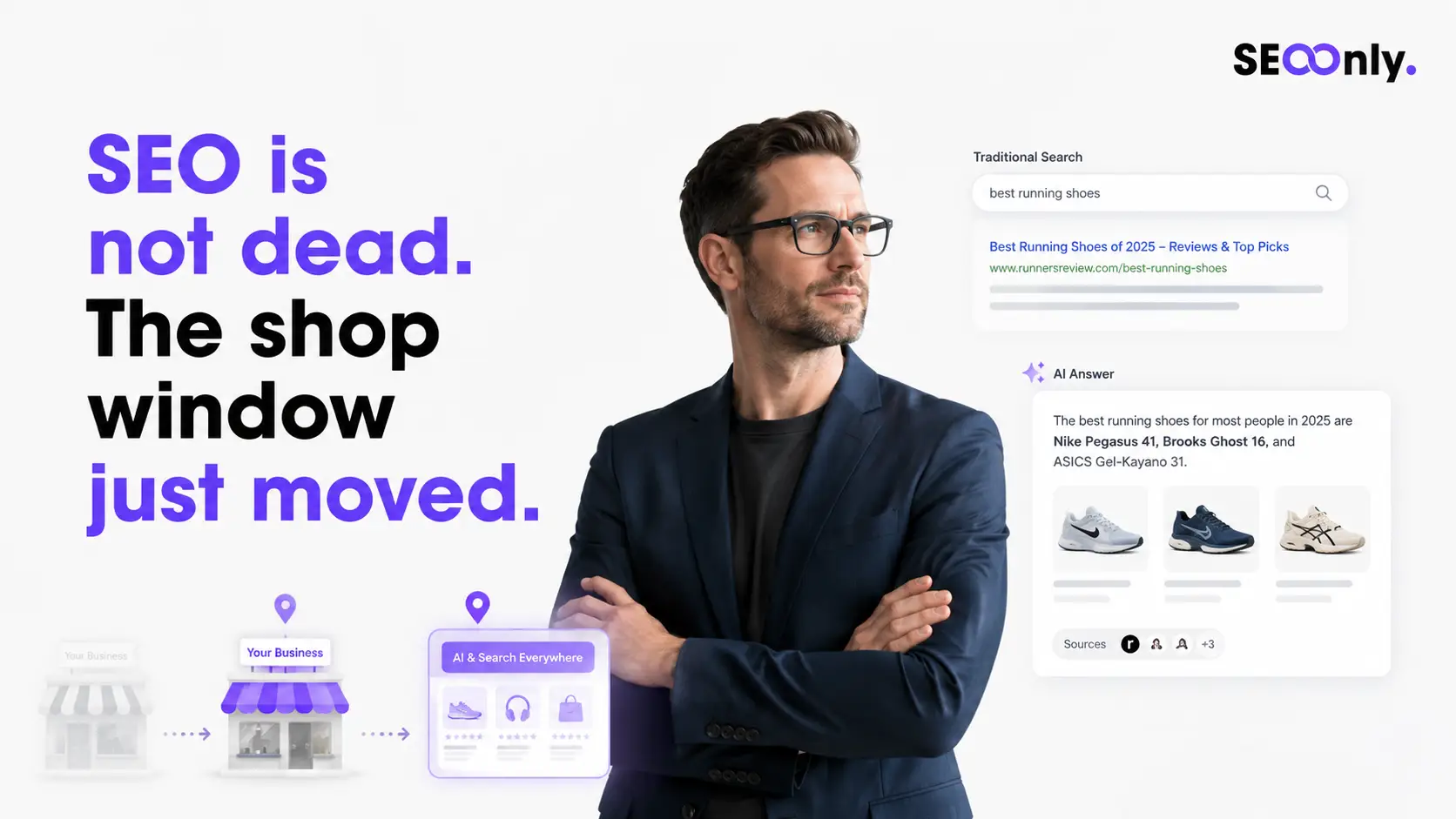
Think of it this way. The shop window moved. It used to be a list of ten links. Now it is often a short AI answer that names a few businesses. If that sounds like the death of SEO, it is not. It is SEO with a new front row.
And here is the part the panic ignores completely. People do not blindly trust the AI. BrightLocal’s 2026 research found that only 18% of people felt ready to contact a business straight off an AI recommendation, and 43% of those who started with AI then went to Google to check the business out. The click did not vanish. It moved further down the journey, to the moment someone decides you are worth calling.
Why the fundamentals still win
Here is the good news for every business owner reading this. The things that get you into an AI answer are the same things that always made a website strong. Nothing exotic.
- Clear pages that answer real questions. The AI pulls its answers from content that actually addresses what people ask. Vague brochure pages get skipped.
- A strong, accurate Google listing. That free Google panel with your hours, reviews and phone number is a signal both Google and the AI tools trust.
- Genuine reviews, kept fresh. Reviews remain one of the strongest local ranking signals, and they help the AI decide who to name.
- A fast, tidy website that both Google and AI can read without tripping over.
Notice something? None of that is new. It is the same AI-Powered SEO work that has always mattered, just pointed at a slightly different finish line.
What “SEO is dead” really means
When someone tells you SEO is dead, translate it. What they usually mean is “the lazy version of SEO is dead.” And that part is true.
Stuffing a page with keywords is dead. Thin, copied content is dead. Buying a hundred dodgy links is dead. Those tricks stopped working years ago, and the AI shift has buried them for good.
Picture two cafes in Hobart. One chases whatever shortcut is trendy this month. The other quietly keeps its Google listing perfect, collects a steady stream of reviews, and answers real customer questions on its website. When someone asks an AI for “a good breakfast spot near me”, which one has given the machine something to work with? The boring, consistent one wins every time.
What this actually means for your business
So where does this leave you as a business owner? Not chasing the latest trick, and not sitting frozen because a headline scared you.
It means widening the goal. You are no longer just trying to rank in a list of links. You are trying to be the clear, trusted answer wherever your customer looks, in the map, in the classic results, and inside the AI answer. The same work feeds all three.
It also means the gap between good and lazy businesses is widening fast. When AI hands out a shortlist of two or three names instead of a page of ten links, being “somewhere on page one” is not good enough anymore. You either make the shortlist or you do not. That sounds harsh, but it is actually the opportunity. Most of your competitors are still doing the bare minimum, or nothing at all.
Picture two accountants in Perth. One reads “SEO is dead”, shrugs, and stops. The other keeps quietly answering client questions on their site and gathering reviews. Six months later, guess which one the AI names when someone asks for a good local accountant. The one who kept going.
The bottom line
SEO is not dead. It grew up. It stopped being about gaming a search engine and became about genuinely being the best, clearest, most trusted answer to what your customers want.
The businesses that understand this are pulling ahead right now, while their competitors wait for a headline to tell them it is safe to start. Do not be the one waiting.
Want to know where your business actually stands in search and AI today?
Get a complimentary SEO review from SEOOnly. No hard sell. No pressure. Get in touch.
Sources
- TechCrunch, “ChatGPT reaches 900M weekly active users” (Feb 2026): techcrunch.com
- Pew Research Center, “Google users are less likely to click on links when an AI summary appears” (US, Jul 2025): pewresearch.org
- SparkToro, 2024 Zero-Click Search Study (US, Jul 2024): sparktoro.com
- BrightLocal, Consumer Search Behavior research (US, 2026): brightlocal.com
Related services
How SEOOnly can help
About the author
Vicky Miller
Head of SEO at SEOOnly
Vicky heads SEO at SEOOnly, helping businesses worldwide turn search visibility into measurable growth across Google and AI search. He writes on technical SEO, content strategy, and the shift to answer engines.
LinkedInLast updated September 8, 2026