SEO vs Google Ads: Which Gives Better ROI for Australian Small Business?
Here is the question we get asked more than any other. “Should I put my money into SEO or Google Ads?”
It is a fair question. You have a limited budget. You cannot afford to waste it. And every provider on the planet will tell you their thing is the answer.
Let me give you the honest version instead. These two are not really enemies. They do different jobs. But if you only have money for one right now, the choice comes down to a few simple trade-offs. Let us walk through them.
The one-line difference
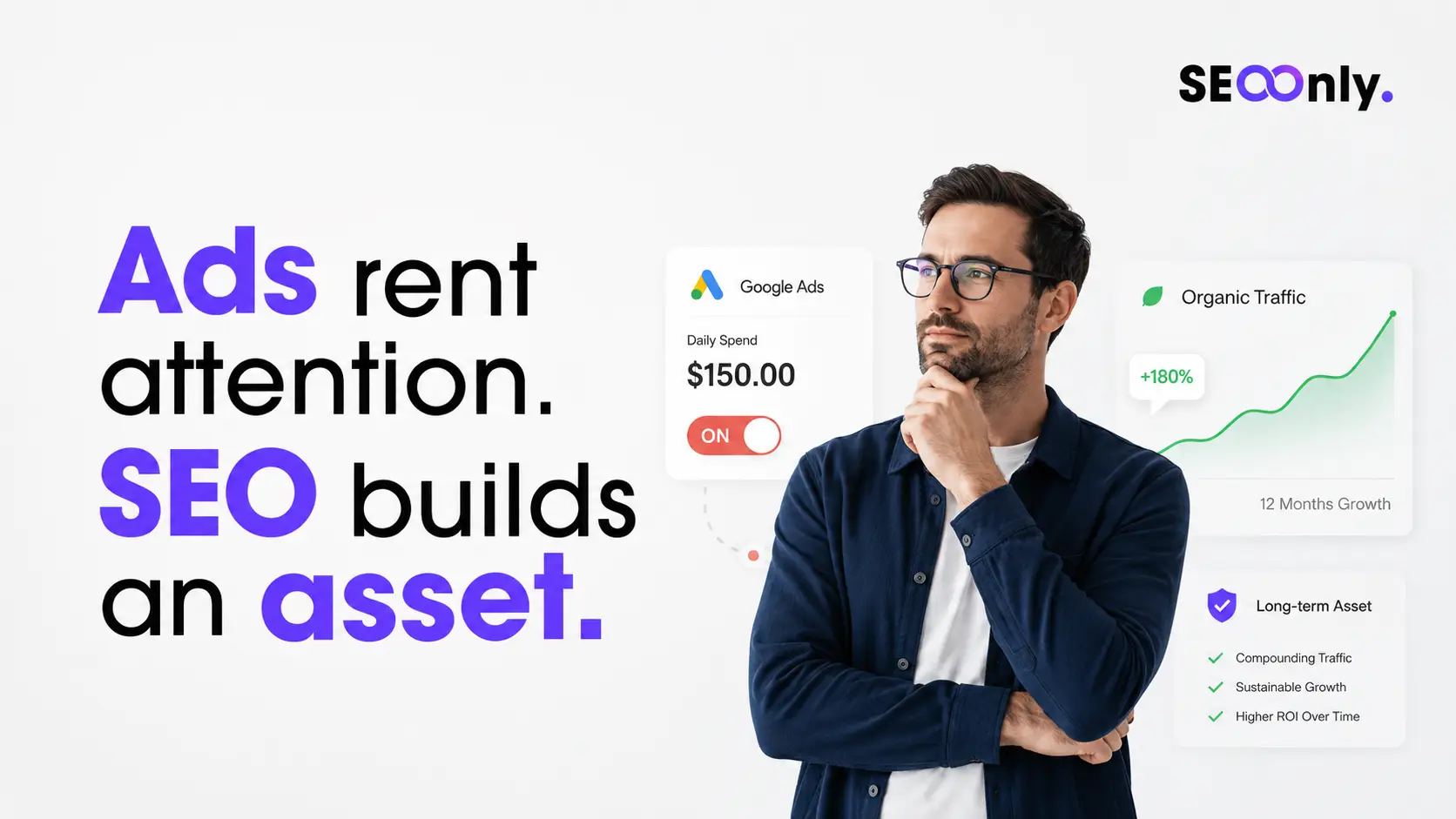
Google Ads is renting. SEO is owning.
With Google Ads you pay to sit at the top of the results. The moment someone clicks, you are charged. The moment you stop paying, you vanish. It is a tap. Turn it on, the traffic flows. Turn it off, it stops that day.
SEO is different. You invest in making your website genuinely deserve to rank, and once it does, that visibility keeps working without paying for each click. It takes longer to build, but it does not switch off the day you stop spending.
Hold that picture in your head, because it explains almost everything about the return you get from each.
Google Ads: fast, but you never stop paying
The big appeal of Google Ads is speed. You can launch a campaign this afternoon and have clicks by tonight. For a brand new business with no visibility, that is powerful.
Ads are also brilliant for testing. Want to know if people actually search for your service and buy? Run a small campaign, see what happens, learn fast.
But here is the catch owners underestimate. The cost never goes away. You are paying for every single click, every day, forever. In competitive markets those clicks are not cheap, and the price tends to climb as more businesses bid. Stop paying and your leads stop the same hour. You are renting your spot, and the rent is due every month with nothing to show for it once you leave.
SEO: slower to start, cheaper to keep
SEO works the opposite way. In the early months you are investing before you see much back. That is the honest truth, and anyone who tells you otherwise is selling something.
But once your pages start ranking, the maths flips. You are no longer paying for each click. A page that ranks well can bring in visitors month after month for a fraction of what the same clicks would cost through Ads. The return builds over time instead of disappearing when you stop.
There is another quiet advantage. People tend to trust the organic results more than the ads. When your business shows up because Google decided you deserve to be there, that carries weight the “Sponsored” label does not.
The trade-off is patience. SEO is a marathon, not a sprint. If you need customers this week, it will not save you. If you want a channel that keeps paying you back next year, it is hard to beat.
What the shift to AI means for both
Here is something that is changing the calculation, and most owners have not caught up to it yet.
The way people search is moving. A US study by the Pew Research Center found that when Google shows one of those AI-written summaries at the top of the results, people click through to a website only 8 per cent of the time, compared with 15 per cent when there is no summary. Fewer clicks overall means the competition for attention is getting tighter.
On top of that, more people are skipping search altogether. ChatGPT reached 800 million people using it every week by October 2025, and 900 million by late February 2026, according to figures reported by TechCrunch. When someone asks an AI tool for a recommendation, there is no ad slot to buy. You cannot pay your way into that answer. You get mentioned because your business has the right signals: a solid website, good reviews, clear information. That is organic ground, and it is exactly what modern AI-Powered SEO builds.
So the ad-only strategy is quietly getting riskier. The channels you cannot buy your way into are becoming more important, not less.
So which one wins on ROI?
Here is the honest answer. It depends on your timeline.
- If you need leads immediately, or you are testing a brand new offer, Google Ads gives you speed. Just know you are paying for every click and it stops when you do.
- If you want the best long-term return, SEO usually wins, because the cost per customer keeps dropping as your rankings hold, while ad costs stay flat or climb.
- If you can manage it, the smartest small businesses run both. Use Ads to capture demand today while SEO builds the visibility that will lower your costs tomorrow.
Do not think of it as SEO versus Google Ads in a fight to the death. Think of it as short game and long game. Ads buy you today. SEO builds your tomorrow.
The trap to avoid
The most expensive mistake we see is businesses that stay on Ads forever and never build anything they own. Year after year they pour money into rented traffic, and the day they pause the campaign, they are invisible again. Nothing accumulated. Nothing to show for it.
Ads are a fine tool. Just do not let them be your only tool. Build something you own alongside them, so that one day the traffic does not depend on your credit card.
Picture a physio clinic in Adelaide running Ads for two years. Great leads, but the moment they pause, silence. A clinic down the road spent those same two years building its rankings and reviews. Now it gets found for free, every day, whether it is spending or not. Same money, very different position.
Not sure whether to put your next dollar into SEO or Ads?
Get a complimentary strategy call from SEOOnly. We will look at your situation and give you a straight answer. No hard sell. No pressure. Get in touch.
Sources
- Pew Research Center, “Google users are less likely to click on links when an AI summary appears” (US, Jul 2025): pewresearch.org
- TechCrunch, “ChatGPT reaches 900M weekly active users” (Feb 2026): techcrunch.com
Related services
How SEOOnly can help
About the author
Vicky Miller
Head of SEO at SEOOnly
Vicky heads SEO at SEOOnly, helping businesses worldwide turn search visibility into measurable growth across Google and AI search. He writes on technical SEO, content strategy, and the shift to answer engines.
LinkedInLast updated September 8, 2026