
How Long Does SEO Actually Take to Work? An Honest Timeline
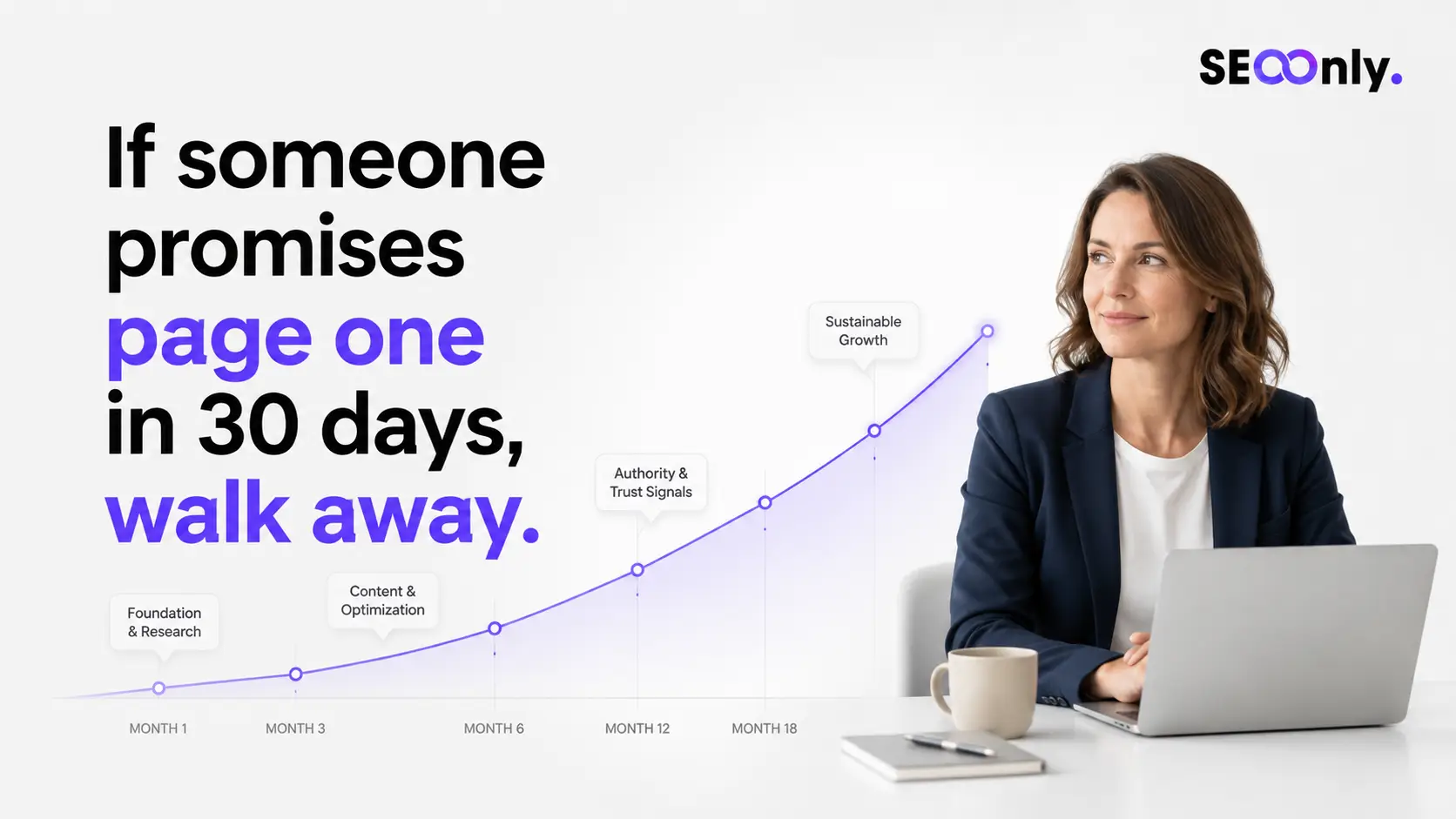
Let me be straight with you. If someone promises you page one in 30 days, walk away.
SEO works. But it does not work overnight, and anyone who tells you it does is either lying or about to use shortcuts that will get your site in trouble.
So how long does SEO really take? The honest answer is usually a few months to see real movement, and six to twelve months to see it properly pay off. Let me show you why, and what should actually be happening along the way, so you know whether your money is working.
Why it takes time in the first place
Here is the thing most people never get told. You do not control the timeline. Google does.
Think of your website as a new shop that just opened on a street Google has never walked down. Before Google will recommend you to anyone, it has to find you, read your pages, decide what you are about, and then decide whether you deserve to be shown ahead of businesses that have been there for years.
That takes time. Google has to re-read your site after every change, watch how people respond, and slowly build trust. There is no button that makes it happen faster. It is a bit like earning a reputation in a new town. You cannot rush it, you have to earn it.
And the competition is real. A US study by SparkToro found that for every 1,000 Google searches, only around 360 clicks reach the open web, because so many searches end without anyone clicking. Getting one of those clicks means genuinely earning your place, and earning takes patience.
The honest month-by-month picture
Every business is different, so treat this as a general shape, not a promise. But this is roughly how a solid campaign unfolds.
Month one: the groundwork. This is the least glamorous part and the most important. Your provider audits the site, fixes technical problems, sorts out your Google listing, and plans the content. You will not see ranking jumps yet. You are laying foundations. Skipping this is why so many campaigns fail later.
Months two and three: early signs. Now the work starts to show. New and improved pages get read by Google. You might see some keywords begin to climb, more of your pages getting found, and small lifts in traffic. Nothing dramatic, but the needle starts to move. This is the stage where you should feel things are heading somewhere.
Months four to six: real traction. This is usually where it gets exciting. Pages that were stuck on page three start reaching page one. Enquiries and calls begin to pick up. The compounding effect kicks in, where each win makes the next one easier. If nothing at all is happening by now, something is wrong.
Months six to twelve: the payoff. This is where SEO earns its keep. Your best pages are ranking, bringing in steady traffic you are not paying for click by click, and the cost per customer keeps dropping. The work you did in month one is still paying you back, and it will keep doing so.
What makes it faster or slower
Two businesses can start on the same day and get very different timelines. Here is what decides it.
- Your starting point. An established site with some history moves faster than a brand new domain with no track record.
- How competitive your market is. A dentist in inner Melbourne faces a longer climb than a specialist trade in a regional town. More competition means more time.
- The state of your website. A slow, broken site has to be fixed before it can grow, which adds time up front.
- How much work goes in. More content and more attention each month generally means faster progress, within reason.
- Consistency. SEO rewards steady, ongoing effort. Start-stop campaigns take far longer to get anywhere.
Why the wait is worth it
I get it. Waiting months is hard when you want customers now. But here is what makes it worth the patience.
Once your rankings are built, they keep working. You are not paying for every click the way you would with ads. And it matters even more now that search is changing. A US study by the Pew Research Center found that when Google shows an AI-written summary at the top, people click through to a website only 8 per cent of the time, compared with 15 per cent without one. Being genuinely visible, and being the business the AI mentions, is what wins now. That kind of trust is exactly what takes time to build and exactly why it lasts. It is what AI-Powered SEO is designed to earn.
Warning signs your SEO is not working
Patience is right. Blind patience is not. If you are several months in and seeing these, ask hard questions.
- No change at all in your rankings or traffic after four to six months of proper work.
- Reports full of vague activity but nothing you can tie to actual results.
- Your provider cannot clearly explain what they did last month or plan to do next.
- Promises of instant results that never arrive.
Do not confuse slow with stalled. Slow is normal. Stalled is a problem. A good provider will show you leading signs of progress well before the big results land, so you never have to guess.
The bottom line
SEO is a marathon. Real movement in a few months, real payoff in six to twelve, and then a channel that keeps working long after you paid for it. Anyone selling you faster than that is selling you risk.
Set your expectations right, pick a provider who is honest about the timeline, and give it the time it needs. The businesses that stick with it are the ones getting found for free, every day, a year from now.
Want an honest read on how long SEO would take for your business?
Get a complimentary SEO review from SEOOnly. We will tell you what is realistic. No hard sell. No pressure. Get in touch.
Sources
- SparkToro, “2024 Zero-Click Search Study” (US, Jul 2024): sparktoro.com
- Pew Research Center, “Google users are less likely to click on links when an AI summary appears” (US, Jul 2025): pewresearch.org
Related services
How SEOOnly can help
About the author
Vicky Miller
Head of SEO at SEOOnly
Vicky heads SEO at SEOOnly, helping businesses worldwide turn search visibility into measurable growth across Google and AI search. He writes on technical SEO, content strategy, and the shift to answer engines.
LinkedInLast updated September 8, 2026