
Podiatry SEO: Why Local Search Matters More Than Your Homepage
Let me be direct. You have probably spent good money on your website.
Nice photos of the clinic. A tidy list of services. Maybe a booking button in a bright colour. And there is nothing wrong with any of that.
But here is the uncomfortable truth. When someone in your area wakes up with a screaming heel or an ingrown toenail and searches “podiatrist near me”, your homepage is almost never the thing that wins them. Something else is doing the real work, and most clinic owners have barely touched it.
What a patient actually sees first
Think about your own behaviour for a second. When you search for a local business on your phone, what fills the top of the screen?
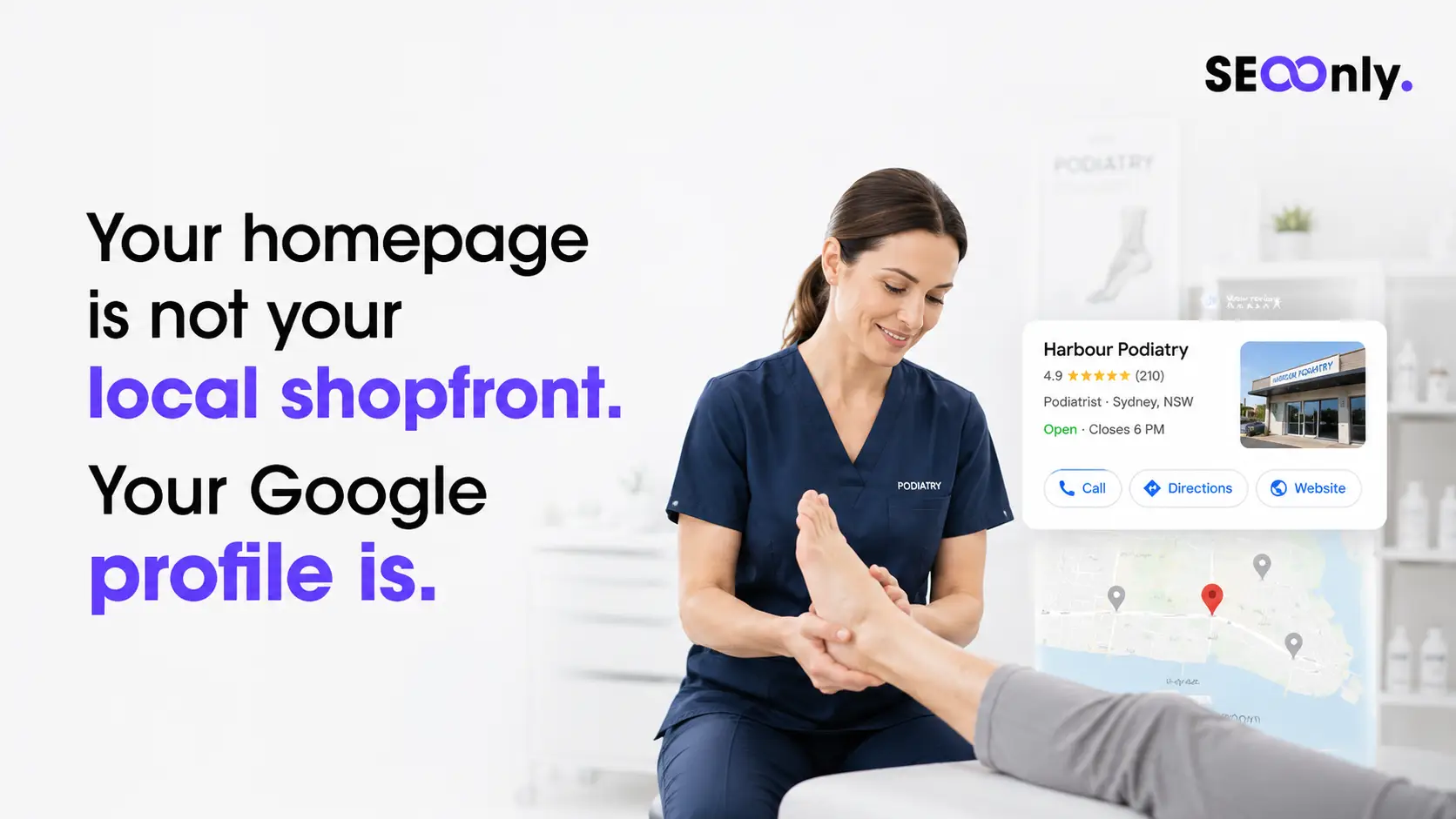
It is not a website. It is the map, with three businesses pinned on it, each with a star rating, a review count, opening hours and a call button. That little block decides most of the outcome before a single website gets a look in.
That panel comes from your Google Business Profile, the free listing Google shows beside the results and in Maps. For a podiatry clinic, that listing is your real shopfront. The website behind it matters, but the listing is what a patient meets first, and it is what most of them judge you on.
BrightLocal’s 2026 research found 84% of people had looked up a local business online in the past three months, and 73% did it on a mobile. On a phone screen, the map and those three listings are basically the whole first impression. Your beautifully designed homepage is sitting further down, and plenty of patients never scroll that far.
Google is where the search happens, and reviews decide it
Google is still the front door for local search. BrightLocal found 52% of people start on Google Search, and 71% use Google at some point in their journey. So this is where a foot-sore patient meets your clinic.
And once they are looking at those three listings, reviews do the deciding. BrightLocal found 84% of people use Google to find business reviews. A patient with heel pain is nervous and in a hurry. They pick the clinic that looks busy, trusted and recently reviewed, not the one with the prettiest logo.
Whitespark’s Local Search Ranking Factors work makes the same point from the other side. Google Business Profile signals and reviews are consistently among the strongest things that decide who ranks in local search, and fresh reviews matter more than old ones. So the clinic with a steady trickle of recent reviews keeps landing in that top three, while the clinic relying on a website redesign wonders why the phone is quiet.
The fix is almost embarrassingly simple. BrightLocal found 96% of consumers are open to writing a review. Most just never get asked. A friendly line at the end of an appointment, “if we sorted that heel out for you, a quick Google review really helps us”, is usually all it takes.
The new front door: patients asking an AI
There is a newer habit forming, and it does not touch your homepage at all.
Some patients no longer type into the search box. They open ChatGPT and ask. “Who is a good podiatrist near me in Adelaide for plantar fasciitis?” ChatGPT reached 800 million people using it every week by October 2025, and 900 million by late February 2026, reported by TechCrunch using OpenAI’s own figures.
BrightLocal’s research shows the shift in local search too. Around 8% of people now start with an AI tool, and 31% use AI at least once a month for a local recommendation. And Google has changed the same way. A study in the United States by the Pew Research Center found that when Google shows an AI summary at the top, people click through to a website only 8% of the time, versus 15% when there is no summary. The answer is served up top, and the click never happens.
Notice what all of this has in common. None of it is your homepage. It is your Google listing, your reviews, and the plain information the AI can pull from them.
Where clinics should actually put their effort
So if the homepage is not the hero, here is what is. This is where a podiatry clinic gets a real return.
- A complete, accurate Google listing. Correct name, address, phone, hours and suburb, with real photos of the clinic and the team. Both Google and the AI tools lean on this listing heavily.
- A steady habit of collecting reviews. Recent and specific beats old and vague. Ask every satisfied patient, every week.
- Pages that match how patients search. A page about “heel pain treatment in Geelong” that answers “will it hurt” and “can I get in this week” will out-earn a generic “Services” page every time.
- Plain answers to the real questions. Cost, whether they need a referral, parking, wait times, what a first visit involves. When your site says this clearly, the AI can quote you with confidence.
A quick example
Picture two podiatry clinics a few blocks apart in Parramatta.
Clinic A spent a fortune on a slick new website. But its Google listing has the wrong hours, no photos, and its last review is from a year ago.
Clinic B has an ordinary website, but forty recent reviews, a listing that matches its details exactly, and a clear page on heel pain.
A patient searches “podiatrist near me” on the couch, foot throbbing. They see the map first. Clinic B is up top, well reviewed and clearly open. Clinic A is somewhere below, and the patient never gets there. The better website lost to the better local presence. And that happens every single day.
What this means for you
Your homepage still has a job. But it is the second thing a patient sees, not the first. The booking is won or lost in local search, in that little block of map, stars and hours, and increasingly in the answer an AI gives when someone asks for a good podiatrist nearby.
That is what AI-Powered SEO looks like for a podiatry clinic. A spotless Google listing, a real habit of reviews, and pages written the way patients actually search. Get those right, and the homepage you paid for finally starts earning its keep.
Want to know if you are showing up when someone searches for a podiatrist near them?
Get a complimentary local SEO review from SEOOnly. No hard sell. No pressure. Get in touch.
Sources
- BrightLocal, Consumer Search Behavior research (US, 2026): brightlocal.com
- BrightLocal, Local Consumer Review Survey (2025): brightlocal.com
- Whitespark, Local Search Ranking Factors: whitespark.ca
- TechCrunch, “ChatGPT reaches 900M weekly active users” (Feb 2026): techcrunch.com
- Pew Research Center, “Google users are less likely to click on links when an AI summary appears” (US, Jul 2025): pewresearch.org
Related services
How SEOOnly can help
About the author
Vicky Miller
Head of SEO at SEOOnly
Vicky heads SEO at SEOOnly, helping businesses worldwide turn search visibility into measurable growth across Google and AI search. He writes on technical SEO, content strategy, and the shift to answer engines.
LinkedInLast updated September 8, 2026