Get Your Real Estate Agency Found in Local Search | SEO for Real Estate | Part 2
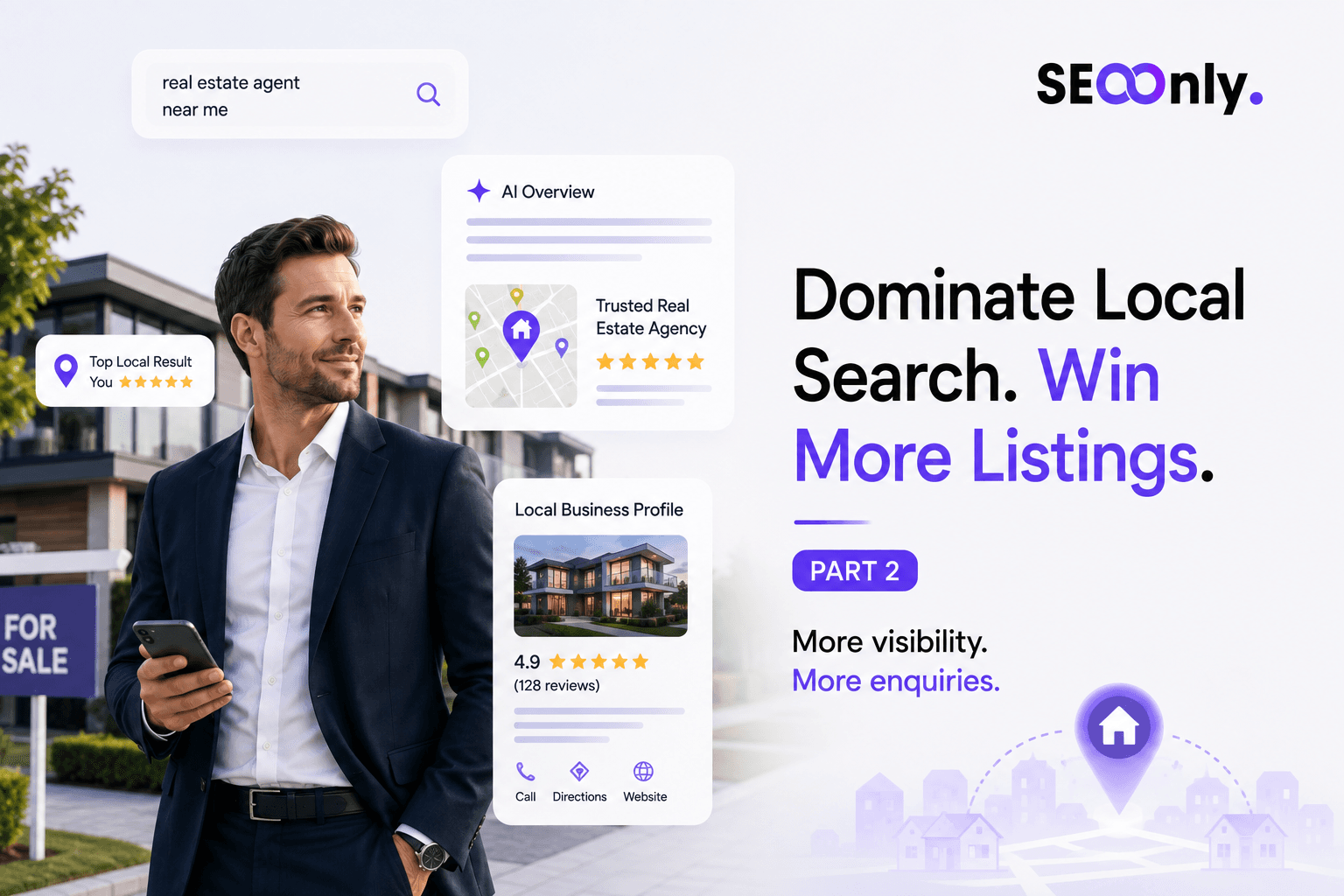
Get Your Real Estate Agency Found in Local Search | SEO for Real Estate | Part 2
When a seller searches for an agent in their suburb, you are either on the shortlist or invisible. Here is how to make sure you are on it.
A homeowner in your area decides to sell. Before they call anyone, they search “Real estate agents” and their suburb on Google. Up comes a map with three agencies pinned to it, star ratings underneath, and a short list below. They tap the first two, glance at the reviews, and pick one to ring. The entire process takes about 90 seconds.
If your agency did not appear on that map, you were never in the running. Not beaten on price, not out-pitched, just unseen. And here is the number that should focus the mind: 72% of consumers look at three or fewer businesses before they decide, and only 6% simply click the top result (BrightLocal, 2026). The shortlist is short, and getting onto it is the whole game.
In Part 1 of this series, we looked at how AI tools like ChatGPT now recommend agencies when buyers and sellers ask them directly. Local search is that same fight on more familiar ground. And here is the part worth being clear about: AI SEO and local SEO are not two different services. They are the same foundational work. The agencies that AI trusts and the agencies Google puts on the map are almost always the same ones, because both run on identical signals: consistent details, genuine reviews, clear local pages. Part 1 covered the AI side. This guide is the hands-on local playbook, the practical work behind getting found in your area, whether the searcher is using Google directly or asking an AI for an answer. If you have not read it yet, start with Part 1: getting recommended by AI.
What is local SEO for real estate agents?
Local SEO for real estate agents is the work of making your agency show up when people in your area search for an agent, in Google’s map results, the local pack and organic listings. It combines an optimised Google Business Profile, consistent business details across the web, genuine reviews, and location-specific pages on your website.
Regular SEO is about ranking for a topic. Local SEO is about ranking for a place. When someone searches with local intent, Google shows a different kind of result: a map with a shortlist of nearby businesses called the local pack, sitting above the usual links. For a real estate agency, that local pack is prime real estate in every sense. It is often the first thing a seller sees and, for many, the only thing they act on.
The good news for agents: local SEO rewards the things you can actually control. Your Google Business Profile, your reviews, the accuracy of your details, and the pages on your own site. You do not need a national brand budget to win locally. You need to get the fundamentals right and apply them consistently across the suburbs and areas you serve.
Why does local SEO matter so much for real estate?
Because property is a local, high-trust decision, and buyers and sellers now shortlist agents online before they ever make contact. If you are not visible in local search, you are excluded from the shortlist before the conversation starts.
Every property decision is tied to a place. Nobody searches for a real estate agent in the abstract; they search for one in their suburb, their city, their corner of the market. That makes local search the front door to your entire business. And the behaviour behind those searches is changing.
Buyers and sellers now build a shortlist before they speak to a soul. As above, most look at three or fewer agencies before deciding. Reviews do heavy lifting in that decision: BrightLocal’s 2026 research found 47% of consumers will not use a business with fewer than 20 reviews, 74% only care about reviews written in the last three months, and 31% will only consider a business rated 4.5 stars or higher. The bar is not just visibility. It is visibility backed by recent, genuine proof.
There is another reason local matters more than ever, and it brings us straight back to AI. The same BrightLocal research found AI tools leapt from 6% to 45% as a channel people use to discover local businesses in a single year, while Google’s share slipped. The foundations that win local search, consistent details, strong reviews, and clear location pages are the very same signals AI leans on when it recommends an agency. Get local right, and you are feeding both channels at once. That is why this sits alongside getting recommended by AI, not apart from it.
How do I set up a Google Business Profile that ranks?
Claim and verify your profile, then complete every field accurately: correct categories, service areas, hours, a keyword-clear description, and regular photos. Keep your name, address and phone identical to your website, and earn reviews consistently.
Your Google Business Profile is the single highest-leverage asset in local SEO. It is what populates the map pack, and for many searchers it is the only thing they read before choosing. Most agencies have one. Very few have optimised it. The difference between a claimed-but-neglected profile and a properly built one is often the difference between page one of the map and nowhere at all.
The essentials, in order of impact:
● Claim and verify the profile. An unverified profile has little chance. If you are a fully mobile agency, set it up as a service area business and list the suburbs you cover rather than a shopfront address.
● Choose the right primary category. “Real estate agency” or “real estate agent” as fits. The primary category carries real ranking weight, so get it exact, then add relevant secondary categories.
● Define your service areas. List the actual suburbs and towns you work in. This tells Google precisely where to show you, and it maps directly to how sellers search.
● Write a clear, specific description. Say what you do and where, in plain terms. “Selling residential property across Geelong’s western suburbs” beats “your trusted local experts” every time, for readers and for Google.
● Add photos, and keep adding them. Recent sold listings, the team, the office. Active profiles with fresh photos signal a live business, and they lift engagement in the pack.
One rule underpins all of it: your business name, address and phone number must be identical here and everywhere else you appear online. Google reads inconsistency as uncertainty, and uncertainty costs you rankings.
How important are Google reviews for real estate agents?
Very. Reviews are one of the strongest local ranking factors and the single biggest trust signal for sellers choosing an agent. Recent, genuine, responded-to reviews in good volume directly affect whether you make the shortlist.
If the Google Business Profile is the asset, reviews are the fuel. They influence both halves of the decision: where you rank in the map pack, and whether a seller who sees you actually calls. The 2026 data is blunt about the thresholds. Nearly half of consumers rule out any business with fewer than 20 reviews. Three-quarters only weight reviews from the last three months and filter for 4.5 stars and up. A glowing review from two years ago does almost nothing for you today.
What that means in practice for an agency:
● Ask every happy client, every time. A simple, consistent request after a successful settlement is the entire engine. Most satisfied sellers will leave a review if asked directly and make it easy.
● Keep them recent. A steady trickle beats a one-off burst. Recency is now its own trust signal, so a review habit matters more than a review campaign.
● Respond to all of them. Consumers expect replies, and a thoughtful response to a tough review can improve how a reader sees you. It also signals an active, engaged business to Google.
Never buy reviews or write fake ones. Beyond being against Google’s policies and a reputational landmine, it fails the one test that matters: a shrewd seller can smell an inauthentic review profile, and so, increasingly, can the AI tools now summarising your reputation.
How do location pages help real estate agents rank locally?
Location pages are dedicated pages on your site for each area you serve, built to answer what local buyers and sellers actually ask. They tell Google exactly where you operate and give you a page to rank for each suburb, rather than relying on one generic homepage.
Your Google Business Profile gets you into the map. Your website is where you prove depth across the areas you serve. A single homepage that says “servicing all of Melbourne” gives Google almost nothing to rank suburb by suburb. A set of genuine location pages, one for each key area, does the opposite: it gives Google a clear, specific page to match against each local search.
What separates a location page that works from thin, spammy filler:
● Make each page genuinely about the area. Real local knowledge: the streets, the property types, recent market conditions, what selling there is actually like. Not the same paragraph with the suburb name swapped in.
● Answer the questions local sellers ask. What are homes selling for, how long are they taking, what should a seller here expect. Useful content is what earns the ranking and the trust.
● Include local proof. Recent sales in that area, reviews from clients there, results that show you actually work the patch.
Done well, location pages are also exactly what AI tools read when deciding which agency to name for a specific suburb. The same page earns its keep in Google’s local results and in AI recommendations. This is the website side of your real estate SEO services, and it compounds over time as each page builds authority for its area.
What else affects how real estate agents rank in local search?
Consistent business details across the web, quality local citations and directory listings, a fast, mobile-friendly site, and links from local sources. Together, these tell Google your agency is a real, established, trusted local business.
Beyond the profile, reviews and location pages, a handful of supporting signals decide the close calls:
● Consistent details everywhere. Your name, address and phone must match across your website, profile, and every directory and portal you appear on. This forms the foundation for everything that follows.
● Local citations. Listings in reputable Australian directories and industry sites. Each consistent mention adds a little confirmation that you are who and where you say you are.
● A fast, mobile-first site. Most local property searches happen on a phone. A slow or clunky mobile site loses both the ranking and the seller.
● Local relevance and links. Mentions and links from local community sites, sponsorships and press signal genuine roots in the area you serve.
How long does local SEO take to work for a real estate agency?
Expect early movement in a few weeks from an optimised Google Business Profile and a review habit, with meaningful ranking gains over three to six months as reviews, location pages and consistency compound. Local SEO is durable once earned, unlike paid leads that stop when you stop paying.
The honest answer is that local SEO is a build, not a switch. Some things move fast: verify and optimise a neglected profile, start gathering recent reviews, and you can see movement in the map pack within weeks. The deeper gains, ranking across multiple suburbs, out-positioning established competitors, come over months as your location pages mature and your review profile deepens.
What makes the wait worth it is durability. A portal lead lasts as long as your subscription. A top-three local ranking, earned properly, keeps delivering enquiries long after the work that won it. Remember, you are building an asset your agency owns, not renting attention by the month.
Frequently asked questions
Why is local SEO important for real estate websites?
Local SEO is important because property searches are tied to a location, and buyers and sellers shortlist agents online before making contact. Without local visibility in Google’s map pack and local results, a real estate website is effectively invisible at the exact moment a seller is choosing who to call.
Do real estate agents need a Google Business Profile?
Yes. A Google Business Profile is what places an agency in Google’s map results and local pack, where most local property searches are decided. Even a fully mobile agency should set one up as a service area business, listing the suburbs it covers rather than a physical shopfront.
How do real estate agents get more Google reviews?
The most effective method is a simple, consistent request to every satisfied client after settlement, with an easy link to leave the review. Keeping the flow recent and steady matters more than a one-off push, because consumers now weight reviews from the last three months most heavily.
Can a real estate agency rank in multiple suburbs?
Yes, with dedicated location pages for each area and accurate service areas on the Google Business Profile. Each location page should carry genuine local knowledge and proof for that suburb, rather than duplicated content, so Google has a specific, credible page to rank for each area.
Is local SEO better than paying for portal leads?
They serve different purposes. The local SEO builds an asset the agency owns, while portal leads stop the moment payment stops. Many agencies use portals for immediate flow while building local SEO for durable, lower-cost visibility over time. The two approaches complement each other rather than replace one another.
Get found where your sellers are searching
If sellers in your area are searching and your agency is not on the shortlist, that is a fixable problem, and it is exactly what we do. SEOOnly helps Australian real estate agencies get found in local search and recommended by AI through our real estate SEO services. It starts with a clear picture of where you rank today, suburb by suburb.
Book a local visibility audit for your agency. We’ll show you where you rank in your suburbs today and what it takes to reach the local shortlist.
Sources
Consumer local search behaviour
● BrightLocal: What makes consumers choose your business? (Consumer Search Behavior 2026) Source for the finding that 72% of consumers look at three or fewer businesses before deciding, and only 6% simply click the top result.
● BrightLocal: Local Consumer Review Survey 2026 Source for review-behaviour figures, including that 47% won’t use a business with fewer than 20 reviews, 74% weight reviews from the last three months, and 31% require 4.5 stars or higher, plus the rise of AI tools as a local discovery channel.
AI adoption in Australia
● Telsyte: Australia’s AI user base surges past 17 million (Telsyte Australian Artificial Intelligence Study 2026). Context for the growing role of AI alongside traditional local search.
Related services
How SEOOnly can help
About the author
Vicky Miller
Head of SEO at SEOOnly
Vicky heads SEO at SEOOnly, helping businesses worldwide turn search visibility into measurable growth across Google and AI search. He writes on technical SEO, content strategy, and the shift to answer engines.
LinkedInLast updated September 8, 2026