Get Your Real Estate Agency Recommended by AI | SEO for Real Estate | Part 1
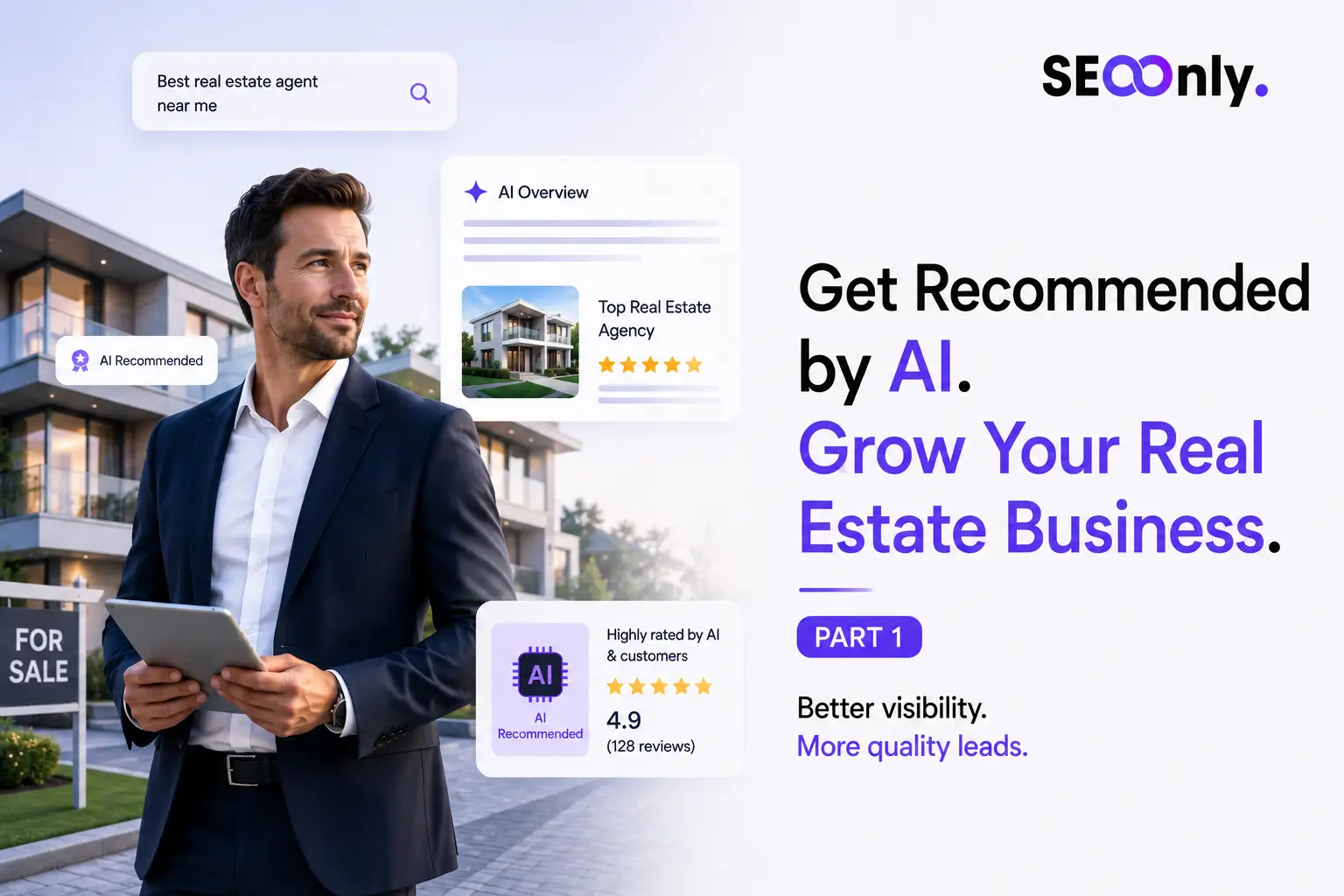
Get Your Real Estate Agency Recommended by AI | SEO for Real Estate | Part 1
When Australian buyers and sellers ask ChatGPT who to trust, GEO decides whether your agency is in the answer.
Picture a seller in Geelong on the couch on a Sunday night. They open ChatGPT and type: “I’m selling my three-bedroom house in Highton, how do I choose a good agent, and who’s actually good around here?” A few seconds later they have an answer. Not ten blue links. A shortlist of two or three agencies, with a sentence on why each one is worth a call.
Here is the part that should stop you cold. None of those agencies is yours, and you will never know that seller existed. No enquiry, no missed-call notification, nothing. The conversation happened, a decision started to form, and your agency was not in the room.
This is already happening in Australia. This guide explains what AI SEO for real estate actually means, why GEO now decides who gets recommended, and what your agency can do to be the name AI puts in the answer.
What is AI SEO for real estate?
AI SEO for real estate is the work of making your agency’s website visible and recommendable inside AI tools like ChatGPT, Gemini and Google’s AI Overviews, so that when a buyer or seller asks AI for an agent, your agency is named. It is the AI-search side of modern SEO, not a separate service, driven by GEO, Generative Engine Optimisation.
Traditional SEO gets you ranked on a list of blue links. AI-powered SEO gets you named inside the answer itself. The techniques share a foundation with the local SEO you may already know; just that the finish line is different. Instead of ranking tenth on a page, you are one of two or three agencies an AI recommends by name. In AI answers, there is no page two. You are either recommended or not.
You will hear a few KEY terms used in this space. GEO (Generative Engine Optimisation) is being recommended inside AI tools like ChatGPT and Gemini. AEO (Answer Engine Optimisation) is appearing in answers like Google’s AI Overviews. For an agency owner, treat them as two sides of the same job: becoming the direct answer, not just a link near it.
Why does AI search matter for real estate agents now?
It matters because most Australians now use AI, and a growing share ask it to recommend businesses before they search anywhere else. Telsyte’s Australian Artificial Intelligence Study 2026 found 17.4 million Australians now use AI, 77% of the population aged 16 and over, with the user base growing by over 6 million in a single year.
Australians are not just using AI more; they are using it harder. According to Telsyte, 5.2 million Australians now use AI every day, marking a 160% year-on-year increase. For discovery-driven industries, the most critical shift is in how people search: 12% of Australians now rely on an AI tool as their primary source for online information; more than double the 5% recorded just twelve months ago. That is one in eight potential clients reaching for a chat window before a search bar.
ChatGPT leads Australia’s AI landscape with 13.8 million users, ahead of Google Gemini at 9.1 million, Meta AI at 5.6 million and Microsoft Copilot at 5.4 million (Telsyte, June 2026). Whichever tool your customers prefer, the behaviour is identical. Users ask complete, natural questions and expect a clear, immediate answer.
For your customers, those questions sound like this:
- “Who are the best real estate agents in Parramatta for selling a family home?”
- “Which Geelong agency achieves the highest sale prices for units?”
- “I’m a first home buyer in Ipswich, which local agents should I talk to?”
- “Is [your agency name] any good? What do people say about them?”
Every buyer or seller query used to start on Google and end on your website or portal profile. Increasingly, it starts and ends inside an AI answer.
The shift, at a glance
Same seller. Same suburb. A decade apart.
| A decade ago: how a seller found an agent | 2026: how a seller finds an agent |
| Typed a suburb and “real estate agent” into Google | Asks ChatGPT or Gemini a full question in plain language |
| Scrolled ten blue links and a few portal profiles | Gets a shortlist of two or three named agencies back |
| Cross-checked on REA and Domain | Acts on the AI answer, often before visiting a portal |
| Asked friends and family for a referral | Trusts the AI recommendation as pre-vetted research |
Why is real estate more exposed to AI search than other industries?
Because property decisions are high-value, research-heavy, deeply local and comparison-driven, exactly the questions AI is built to answer, and because agencies have relied on portals instead of building their own visibility.
Four things make property unusually exposed:
- High-value decisions. People do not choose an agent to sell their biggest asset on a whim. They research, and AI tools are built to do that for them.
- Research-heavy. Buyers and sellers read, compare and second-guess for weeks. AI compresses all of that into one conversation, forming opinions about who to trust before anyone picks up the phone.
- Deeply local. AI handles “agents in Highton” or “best agency in Ipswich for first home buyers” with real geographic precision. Local is where these tools are strongest, and local is your entire business.
- Comparison-led. “Which agency is better?” is a natural question to ask an AI, and a natural answer for it to provide. Your reputation is being summarised whether you take part or not.
Then comes the uncomfortable truth: for years, agencies relied on REA and Domain for visibility, a dependence that quietly eroded their independent online presence. Many neglected the site content, consistent business data, and local authority signals that AI recommendations require. Now, when an AI builds its shortlist, it can bypass those portals entirely, turning rented visibility from a safety net into a liability.
At the same time, the real estate market is increasingly crowded. IBISWorld reported that employment in Australia’s real estate services industry was more than 163,000 in 2025. When an AI narrows a market of that size down to three names, you want to be one of them.
How do real estate agents get found and recommended by AI?
AI recommends agencies with consistent business details, a clear identity, verifiable reviews, content that answers real questions, and structured data it can read. Get those signals right, and AI can confidently name you when a customer asks.
You do not need to understand the machinery to understand the idea. AI tools weigh a handful of signals when deciding who to recommend. Here is what they look for:
- Consistent identity everywhere. Your agency name, address, phone number and service areas need to match exactly across your website, Google Business Profile and every directory. Mismatched details make an AI unsure who you are, and uncertainty means it leaves you out.
- A clear sense of who you are. AI needs to grasp what you do, where you operate and what you specialise in. “Hardworking local agents” tells it nothing. “Selling family homes in Geelong’s western suburbs since 2009” tells it plenty.
- Reviews and mentions it can verify. Current reviews and mentions on reputable sites are how AI platforms confirm your credibility rather than just noticing your existence. It is looking for corroboration it can point to.
- Content that answers real questions. When your site clearly answers what buyers and sellers actually ask, AI can lift those answers and attribute them to you. Vague marketing copy gives it nothing to work with.
- Structure a machine can read. Behind the scenes, structured data helps AI read your listings, service areas and credentials cleanly. While setting up technical markup is best handled by an SEO specialist, it is worth knowing it exists and that it matters.
None of this is trickery. It is the same principle that has always won in local search: be clear, be consistent, be genuinely useful, be verifiable. AI has simply raised the reward for doing it well. This is why AI-powered SEO sits inside your broader real estate SEO services, not beside them; both share the exact same foundations.
What does an agency gain from AI SEO?
Recommendations at the moment of highest intent, visibility before the portals, standing as the known agency in your area, and a lead source you own rather than rent.
AI SEO transforms lead generation for real estate agencies:
- Recommended at the moment of highest intent. Someone asking AI “who should sell my house” is close to choosing. Being named there is being named at the decision point.
- In front of customers before the portals are. When AI answers directly, the customer may act on that shortlist without opening REA or Domain. You reach them earlier, on your own terms.
- Known as the local agency. Get consistently recommended for your suburbs, and you build local authority that compounds. The more you are cited, the more you get cited.
- A lead source you own. Portal leads stop the day you stop paying, while visibility you have earned in AI search keeps working for you.
In the language that matters to an owner: more appraisals, more listings, more standing in your market. Not traffic for its own sake, but leads that turn into signed authorities.
What can I start doing about AI SEO now?
Start by making your business details identical everywhere, optimising your Google Business Profile, answering your clients’ real questions on your site, and keeping reviews current and genuine.
You do not have to solve all of this today, and the technical work is not a do-it-yourself job. But there are first moves any owner can begin now.
- Check that your business details are identical across every online touchpoint. Even small mismatches muddy the signal.
- Claim and properly fill out your Google Business Profile, with accurate service areas and a clear description of what you do.
- Notice the questions your clients actually ask, then make sure your website answers them plainly.
- Keep your reviews current and genuine. They are among the strongest trust signals an AI can verify.
Think of these as the first moves, not the whole game. They point you in the right direction while the deeper work gets done properly.
Is it too early to invest in AI SEO for real estate?
No. The behaviour shift is documented, and most competitors are not acting yet, so early movers earn recommendations that compound. AI referral tracking is still immature, so treat this as positioning for where search is heading, not a fully measurable channel today.
Most of your competitors are still treating AI as a curiosity rather than a channel. The agencies that move now will earn the recommendations, and those recommendations tend to compound and stick. Early movers in a new discipline usually get a head start that is very hard to catch later.
A word of honesty, because you deserve the straight version. You cannot yet measure this channel the way you measure Google clicks or portal leads, and anyone promising a tidy dashboard of AI-sourced listings tomorrow is overselling it. This is about positioning your agency for where search is clearly heading. The behaviour shift is real and documented; the measurement will catch up, and the visibility you build in the meantime does not wait for it.
AI SEO and local SEO are the same job
Here is the point that ties all of this together, and it is the one most agencies miss. AI SEO and local SEO are not two separate services you choose between. They are the same foundational work, read by two different audiences. The consistent business details, the genuine reviews, the clear location pages, the useful content: those exact signals are what get you named by ChatGPT, and they are what put you in Google’s local map pack. Do the foundations well and you win in both places at once. Neglect them and you lose in both.
That is why this series treats them as one discipline, not two. This piece covered the AI side: why it matters and how recommendations work. The next one goes hands-on with the local side, the Google Business Profile, the reviews, the suburb pages that get your agency onto the map. If you want the practical playbook for being found in your own area, read Part 2: getting found in local search. Same foundations, the other half of the payoff.
Frequently asked questions
What is GEO for real estate?
GEO, or Generative Engine Optimisation, for real estate is the practice of structuring your agency’s online presence so AI tools like ChatGPT, Gemini and Perplexity cite and recommend you when someone asks for an agent. It is the same foundation as local SEO, aimed at AI answers instead of blue links.
How do real estate agents get found on ChatGPT?
Agents get found on ChatGPT by keeping consistent business details across the web, earning genuine reviews and mentions on trusted sites, and publishing clear, structured content that answers the questions buyers and sellers ask. ChatGPT draws on these signals to decide which agencies to name.
Will AI replace real estate portals like REA and Domain?
Not entirely, but AI is changing how buyers and sellers discover agents before they reach a portal. When someone asks AI for an agent, they may act on that shortlist without opening REA or Domain. Agencies that rely only on portal visibility are the most exposed to this shift.
Is AI SEO different from traditional SEO?
AI SEO is a dimension of traditional SEO, not a separate service. Traditional SEO focuses on ranking in Google’s blue links, while AI-powered SEO focuses on being named inside AI answers. Both share the same foundation of consistency, authority and useful content.
How much does AI SEO cost for a real estate agency?
Cost depends on the state of your current visibility, how many locations you cover and how competitive your market is. Because AI SEO sits within broader SEO work rather than beside it, it is usually scoped as part of an overall SEO engagement rather than a standalone line item. The honest first step is an audit of where your agency stands today.
See where your agency stands
If you want to know whether AI tools currently recommend your agency, and what it would take to change the answer, that is exactly the work we do. SEOOnly helps Australian real estate agencies get found and recommended across Google, ChatGPT, Gemini and the other AI tools your customers now use. It starts with our real estate SEO services and a clear picture of where you stand today.
Book an AI visibility audit for your agency. We’ll show you what AI says about you today, and where your local competitors already have the edge.
Sources
AI adoption in Australia
- Telsyte: Four in five AI users now engage monthly as Australia’s user base surges past 17 million (Telsyte Australian Artificial Intelligence Study 2026, published 2 June 2026). Source for all AI adoption and usage figures in this article, including the 17.4 million user base, daily-use growth, platform market share and the shift to AI as a primary way of finding information.
Australian real estate industry size
- IBISWorld: Real Estate Services in Australia (industry employment data, 2025). Source for the scale of Australia’s real estate services industry.
Related services
How SEOOnly can help
About the author
Vicky Miller
Head of SEO at SEOOnly
Vicky heads SEO at SEOOnly, helping businesses worldwide turn search visibility into measurable growth across Google and AI search. He writes on technical SEO, content strategy, and the shift to answer engines.
LinkedInLast updated September 22, 2026