Is ChatGPT Recommending Your Competitors? A Law Firm’s Guide to AI Visibility
Here is something most firm owners never think about.
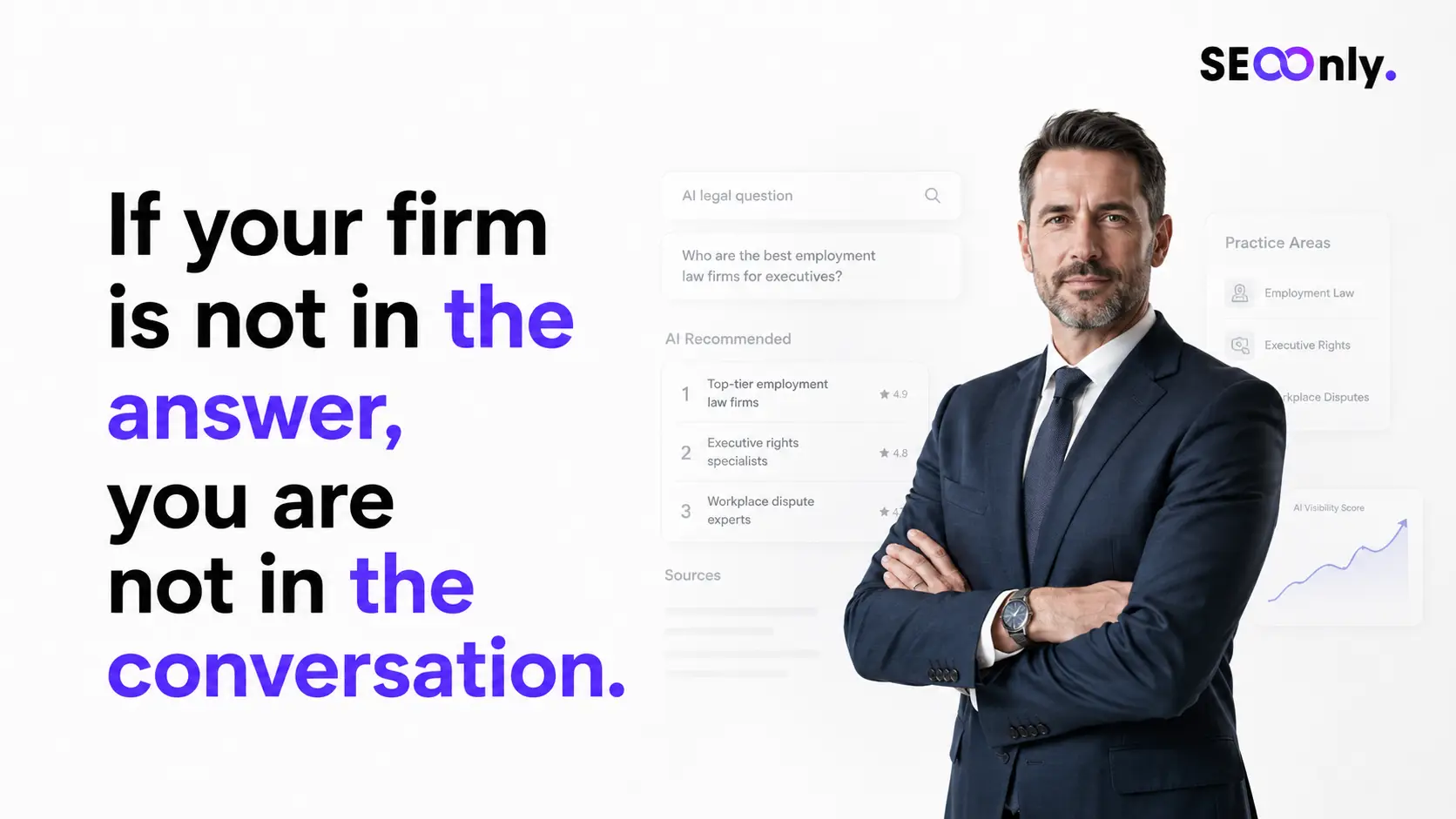
Right now, somewhere in your city, a person with a legal problem is not typing into Google. They are asking ChatGPT. “Who is a good family lawyer near me for a custody matter?” And whatever names come back, those are the firms that get the call.
If your firm is not one of them, you never find out. You do not appear lower down. You are simply not in the conversation.
Let me be direct. Search has changed, and the way people choose a lawyer has changed with it. This is a guide to staying visible when the answer comes from a machine.
This is not a niche behaviour anymore
The numbers make it hard to wave away.
ChatGPT reached 800 million people using it every week by October 2025, and 900 million by late February 2026, according to TechCrunch reporting OpenAI’s own figures. That is not a small tech crowd. That is the person going through a divorce, the small business owner facing a contract dispute, the family sorting out a will.
Google has moved in the same direction. You have seen it: that AI-written summary sitting at the top of the results, answering the question before a single law firm website gets a look in.
And it changes what people do next. A study in the United States by the Pew Research Center found that when that AI summary appears, people click through to an actual website only 8 per cent of the time. Without a summary, they click 15 per cent of the time. Roughly half the clicks, gone. Only 1 per cent clicked a link inside the summary itself. The AI gives its answer, the person feels informed, and they move on.
So being ranked number one on Google is no longer the whole game. The new question is whether your firm gets named when the AI does the answering.
How people actually choose a lawyer now
Here is the good news for a law firm. People do not blindly trust the robot with something as serious as a legal matter. They check.
BrightLocal’s 2026 research found 84 per cent of people had looked up a local business online in the past three months, and 73 per cent did it on their phone. Google is still the front door, with just over half starting there. But 8 per cent now begin with an AI tool, and 31 per cent use AI at least once a month to get a recommendation for a local business.
Now the part that matters for you. In that same research, only 18 per cent felt ready to contact a business straight off an AI suggestion. And 43 per cent of the people who started with AI then went to Google to check the firm out.
Think about the client with a real legal problem. They ask ChatGPT for a few names. Then they search you on Google, read your reviews, look at your practice pages, and decide whether they trust you enough to ring. You have to win at both ends. Get named by the AI, and look genuinely credible when they double-check.
What actually gets a firm mentioned
None of this is a trick, and none of it is expensive. AI tools pull from the same signals that already make a firm look trustworthy. Your job is to make those signals clear, consistent and easy to read.
- A complete, correct Google listing. Your Google Business Profile is that free panel beside the results and in Maps, with your name, address, phone, hours and area. Both Google and the AI tools lean on it, so keep it accurate to the letter.
- Recent, genuine reviews. A steady flow of current reviews tells everyone that real clients chose you and were glad they did. BrightLocal found 96 per cent of people are open to leaving a review. Most simply never get asked. A quiet request at the end of a matter is often all it takes.
- Pages that talk like a client, not a solicitor. A page built around “contesting a will in Brisbane” that answers “how long does it take” and “what will it cost” beats a vague “Our Services” list every time. Write in the words your clients use.
- Plain answers to the real questions. Fees, first steps, timelines, what happens at a first meeting. When your site answers these clearly, an AI tool can quote you with confidence, because you have made the answer easy to find.
A quick example
Picture two firms in the same building in Adelaide, both doing solid family law.
Firm A has a smart-looking website. But its Google listing has last year’s phone number, the most recent review is from two years ago, and each practice page is one thin paragraph.
Firm B has thirty recent reviews, a listing that matches its website exactly, and a page that explains the divorce process in plain English, step by step.
Now ask an AI for “a good family lawyer near me who is easy to talk to.” For Firm A, there is almost nothing to work with. For Firm B, everything the AI needs is sitting right there. Same building. Completely different visibility. And none of it was luck.
What this means for your firm
The way people find a lawyer has quietly split in two. Some still scroll the Google results the old way. A growing number take the AI’s answer and act on it. You cannot pick which group your next client belongs to, so you have to show up for both.
That means a spotless Google listing, a real habit of gathering reviews, and a website written for anxious human beings that machines can also read cleanly. That is what AI-Powered SEO looks like for a law firm. Not clever hacks. Just the right trust signals, done consistently.
The firms treating this as normal marketing, rather than a job for “someday”, are the ones getting named in those answers right now. Most of your competitors have not started. That is your opening.
Want to know if AI is recommending your firm, or the practice across the road?
Get a complimentary AI visibility check from SEOOnly. No hard sell. No pressure. Get in touch.
Sources
- TechCrunch, “ChatGPT reaches 900M weekly active users” (Feb 2026): techcrunch.com
- Pew Research Center, “Google users are less likely to click on links when an AI summary appears” (US, Jul 2025): pewresearch.org
- BrightLocal, Consumer Search Behavior research (US, 2026): brightlocal.com
- BrightLocal, Local Consumer Review Survey (2025): brightlocal.com
Related services
How SEOOnly can help
About the author
Vicky Miller
Head of SEO at SEOOnly
Vicky heads SEO at SEOOnly, helping businesses worldwide turn search visibility into measurable growth across Google and AI search. He writes on technical SEO, content strategy, and the shift to answer engines.
LinkedInLast updated September 8, 2026