Trust Signals That Matter for Financial Services SEO in 2026
Let me ask you something.
Would you hand your life savings to someone you found thirty seconds ago and knew nothing about?
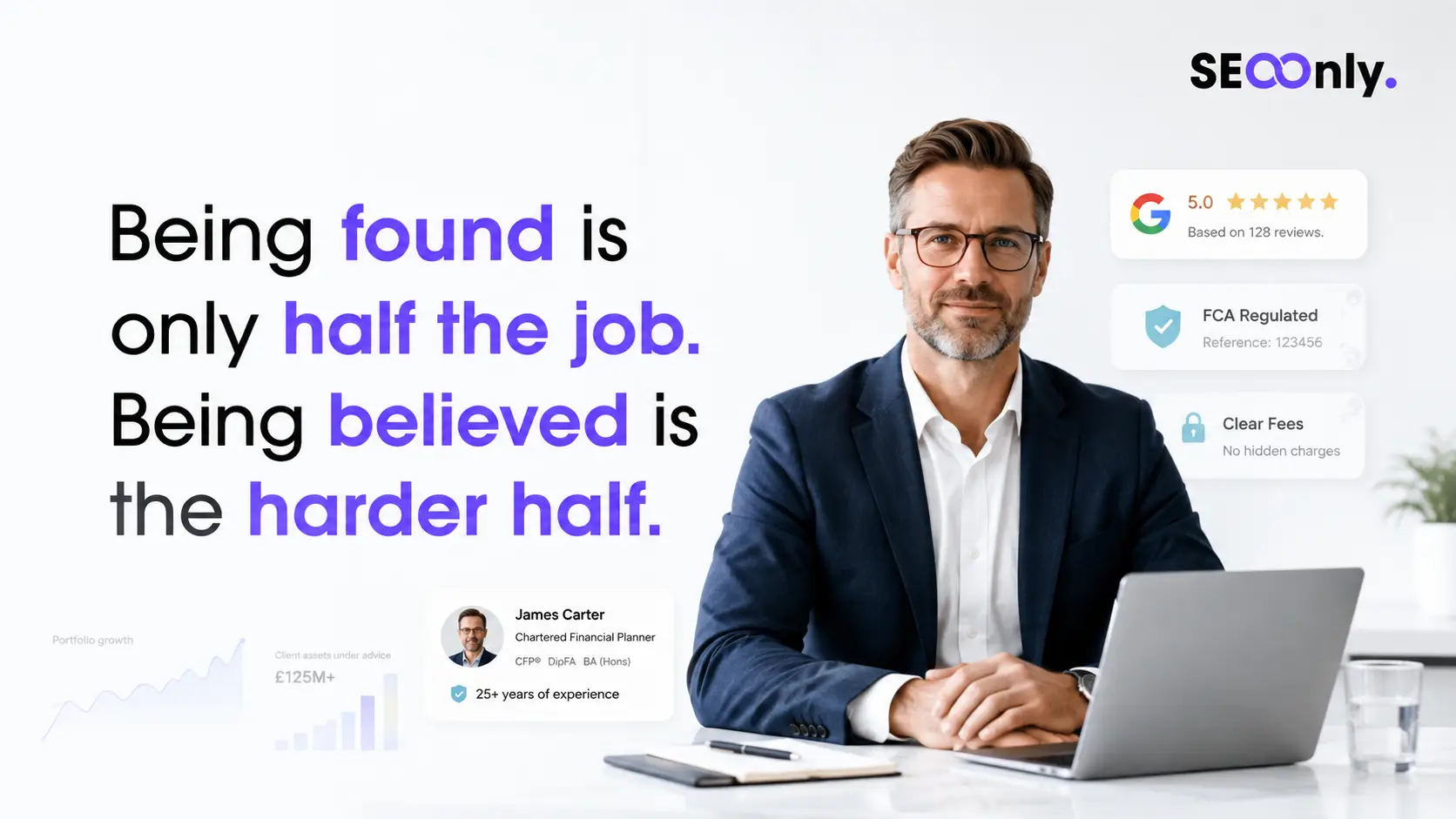
Of course not. And neither will the person searching for a financial adviser in Brisbane tonight. This is the thing that makes financial services marketing different from almost every other kind. Being found is only half the job. Being believed is the other half, and it is the harder half.
You can rank first for every keyword you like. If the person who lands on your page does not trust you within a few seconds, they are gone, and they are ringing the adviser who felt safer. So let us talk about the signals that actually build that trust, online, in 2026.
Why trust is now the whole game
Search has quietly changed, and it changed in a way that raises the bar on trust.
A lot of people no longer start by typing “financial adviser near me” into Google. They ask ChatGPT or another AI tool directly: “How do I find a good financial adviser, and what should I ask them?” ChatGPT reached 900 million people using it every week by late February 2026, as reported by TechCrunch using OpenAI’s own figures. Google has changed too, with those AI-written summaries now answering questions at the top of the results before any website is clicked.
A United States study by the Pew Research Center found that when an AI summary appears, people click through to a website only 8% of the time, compared with 15% when there is no summary. Fewer clicks means each one matters more. The visitor who does reach your site has already narrowed things down. They are not browsing. They are checking whether to trust you.
Here is the reassuring part, though. In financial services, people verify obsessively, and that works in your favour if you have your house in order. In BrightLocal’s 2026 research, only 18% of people felt ready to contact a business straight off an AI recommendation, and 43% of AI-first searchers then went to Google to check. Nobody picks an adviser on a chatbot’s word alone. They dig. Your job is to reward the digging.
The trust signals that actually move the needle
None of these are tricks. They are the honest markers of a credible practice, made visible and consistent so that both people and machines can see them.
- A complete, accurate Google Business Profile. That is the free Google panel with your name, address, phone and hours beside the results and in Maps. Whitespark’s ongoing research consistently ranks Google Business Profile signals and reviews among the strongest local ranking factors. For an adviser, a precise, current listing is the baseline of looking real.
- Recent, genuine reviews. This is the big one. BrightLocal found 84% of consumers use Google to find business reviews, and 96% of people are open to writing one. A steady stream of recent reviews from real clients is the single most powerful trust signal you have. Whitespark notes recency matters, so keep them coming rather than resting on old praise. Most advisers simply never ask. Ask, within what your compliance rules allow.
- Named, credentialed humans. Show the real people. Photos, names, qualifications, licence details, years of experience. A faceless firm reads as risky. A page that says “here is your adviser, here is her background, here is how she is licensed” reads as safe.
- Clear, plain-English answers to money questions. How your fees work. What the first meeting involves. Who you help and who you do not. When your site answers the real, slightly nervous questions plainly, it builds trust with the reader and gives AI tools something clear and credible to quote.
- Visible credentials and memberships. Your Australian Financial Services Licence or authorisation, professional memberships, and any relevant registrations, stated plainly. These are trust anchors, not fine print.
Speed is a trust signal too
Here is one people forget. A slow website does not just cost you rankings. It quietly signals carelessness, and carelessness is the last thing anyone wants from the person handling their money.
Deloitte and Google, in their “Milliseconds Make Millions” study, found that improving mobile load time by just 0.1 of a second lifted lead-generation form submissions by 21.6%. For an adviser, most enquiries are exactly that: a form or a call from someone who has decided to take a first step. A fast, clean, professional site tells that person, before they read a word, that you are organised and on top of things.
What actively destroys trust
It is worth being blunt about the other side. A few things will sink you no matter how well you rank.
Stock photos of models in suits. Vague claims with no substance behind them. A “contact us for details” wall where honest answers should be. No named people. No reviews, or reviews from three years ago. Grand promises about returns. Each one whispers to the visitor: be careful here. And with money, careful means gone.
A tale of two advisers
Picture two financial advisers a few suburbs apart in Perth.
Adviser A has a slick website full of stock imagery and confident slogans. But there is no named adviser, no reviews, and the fees are a mystery until you book a call.
Adviser B has a plain, fast site with real photos, clear credentials, a page explaining exactly how fees work, and a steady flow of recent client reviews.
Now someone asks an AI, or Google, “a trustworthy financial adviser near Perth who is upfront about fees”. Adviser B gives every signal that answer needs. Adviser A gives almost nothing to hold onto. Same profession. Very different level of trust. And it was built, not bought.
What this means for you
Financial adviser marketing in 2026 is not about shouting louder or gaming an algorithm. It is about being genuinely, visibly trustworthy, and making sure that trust shows up in every place a cautious person looks: your Google listing, your reviews, your named team, your plain-English answers, and a website that loads like you mean business.
That is what AI-Powered SEO looks like for financial services. Get the trust signals right, keep them current, and you will be the adviser who not only gets found, but gets believed. In this industry, believed is the one that gets the call.
Want to know whether your practice looks trustworthy to Google, AI tools, and the person about to call?
Get a complimentary SEO review from SEOOnly. No hard sell. No pressure. Get in touch.
Sources
- TechCrunch, “ChatGPT reaches 900M weekly active users” (Feb 2026): techcrunch.com
- Pew Research Center, “Google users are less likely to click on links when an AI summary appears” (US, Jul 2025): pewresearch.org
- BrightLocal, Consumer Search Behavior research (US, 2026): brightlocal.com
- BrightLocal, Local Consumer Review Survey (2025): brightlocal.com
- Whitespark, Local Search Ranking Factors: whitespark.ca
- Deloitte and Google, “Milliseconds Make Millions” (2020): web.dev
Related services
How SEOOnly can help
About the author
Vicky Miller
Head of SEO at SEOOnly
Vicky heads SEO at SEOOnly, helping businesses worldwide turn search visibility into measurable growth across Google and AI search. He writes on technical SEO, content strategy, and the shift to answer engines.
LinkedInLast updated September 8, 2026