Aged Care Website Checklist: What Builds Trust in the First 10 Seconds
Here is something most aged care providers never realise.
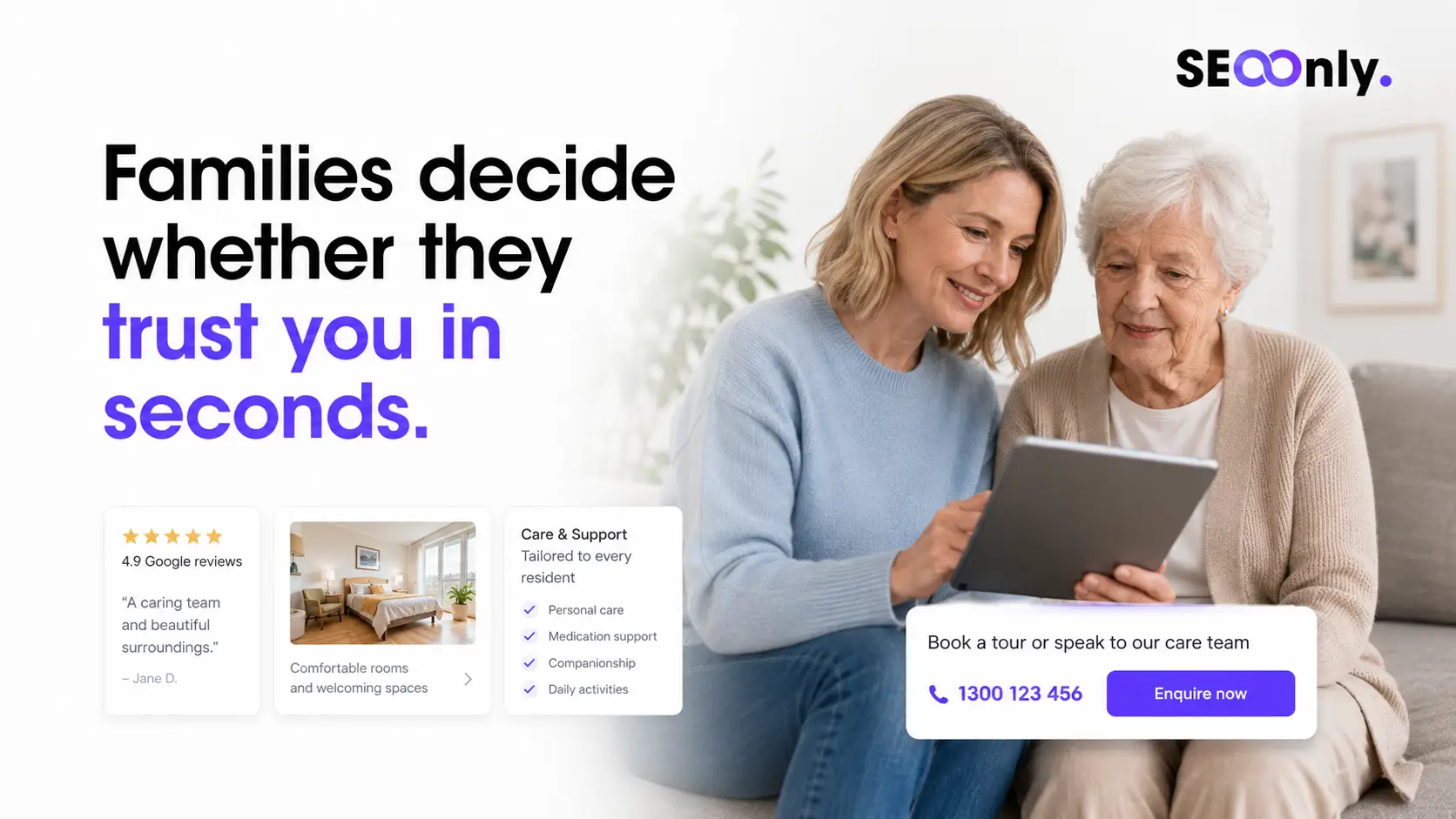
A family will decide whether they trust you in about the time it takes to read this sentence.
They land on your website, tired and stressed, and within a few seconds a quiet judgement has already been made. Does this place feel safe? Do these people seem to care? Can I actually find what I need? They will not tell you they made that call so fast. But they did.
So let us go through what those first ten seconds have to get right. Think of this as a checklist you can hold your own website up against, section by section.
1. It has to load before they lose patience
Speed is not a technical nicety. It is the first thing a visitor feels, before they read a single word.
The numbers are striking. Deloitte and Google, in their “Milliseconds Make Millions” study, found that improving mobile load time by just 0.1 of a second lifted lead-generation form submissions by 21.6%. A tenth of a second. And most aged care enquiries are exactly that: a form or a phone tap from a worried family.
Since the majority of these searches happen on a phone, often on patchy home wi-fi late at night, a slow, heavy website quietly bleeds away the very people you most want to reach. Check it. Load your own site on your mobile, on mobile data, and count.
2. The headline has to say who you are and where
Within one glance, a visitor should know three things: what you do, where you are, and who you are for.
“Residential aged care and respite in Adelaide’s eastern suburbs” tells a family everything in a breath. “Welcome to our website” tells them nothing. Put the plain, human version of what you offer, and the suburb you offer it in, right at the top where the eye lands first.
3. Real photos of the real place
Stock images of smiling strangers do the opposite of what you hope. Families can smell them, and they wonder what you are hiding.
Show your actual rooms, your actual garden, your actual dining area and staff. It does not need a professional shoot to start with. It needs to be true. A real photo of a sunny common room does more for trust than any amount of polished copy.
4. Recent reviews, easy to find
This is where trust is won or lost, and most homes underuse it badly.
BrightLocal found that 84% of consumers use Google to find business reviews, and 96% of people are open to writing one. For aged care, a warm, recent review from another family is the single most reassuring thing a nervous visitor can see. Yet most providers never ask, so the newest review is years old, or there is none at all.
Make asking part of your routine. Then surface those reviews on your site, and keep your Google presence full of fresh ones. Whitespark’s ongoing research consistently ranks reviews and Google Business Profile signals among the strongest factors in local search, and it notes that review recency matters. Old reviews age like milk, not wine.
5. The hard questions answered in plain English
A family lands on your site with a short, frightening list of questions. What does it cost? Is there a waitlist? What happens as Mum’s needs increase? Can she bring her things, or her cat?
If your website makes them dig, or worse, just says “contact us for details”, many will quietly leave and try the home down the road that simply told them. Answer the real questions in plain words. It builds trust, and it gives AI tools something clear to quote when a family asks a chatbot for help. That is what AI-Powered SEO looks like in practice: being the clearest, most honest answer to a real human question.
6. An obvious, gentle next step
Once trust is built, do not leave the family guessing what to do. A clear phone number at the top. A short enquiry form that does not demand their life story. A friendly “book a tour” or “talk to us” invitation that feels like an open door, not a sales pitch.
Remember that this decision is emotional. The tone of your call to action matters as much as its placement.
7. It works on a phone, and it works for everyone
The person researching is very often an adult child on a mobile. The person moving in may be older, with fading eyesight. Both have to be able to use your site.
That means text large enough to read comfortably, buttons big enough to tap, good colour contrast, and a layout that reflows neatly on a small screen. Accessibility here is not a box to tick. It is a signal that you understand who you serve.
Why this all matters more than ever
Families do not decide on a website alone, and they do not decide quickly. BrightLocal’s 2026 research found 75% of people used more than one channel before choosing a local business, and 73% searched on mobile. A family will find you on Google, check your reviews, glance at a directory, then land back on your website to make up their mind.
There is a newer layer too. Many now start by asking an AI tool, “what should I look for in a good aged care home near me?” ChatGPT alone reached 900 million weekly users by late February 2026, as reported by TechCrunch. But people do not blindly trust it: only 18% in BrightLocal’s research felt ready to contact a business straight off an AI suggestion, and 43% of AI-first searchers then checked Google. Your website is where that checking ends. If it fails the first ten seconds, none of the earlier good work counts.
Run the checklist
Open your own website on your phone, right now, and go down the list. Does it load fast? Does the headline say who and where? Are the photos real? Are the reviews recent? Are the hard questions answered plainly? Is the next step obvious? Does it work for an older visitor?
Every “no” is a family you are quietly losing in those first ten seconds. The good news is that every one of them is fixable, and none of it is expensive. It is just care, made visible.
Want an honest read on whether your website earns trust in the first ten seconds?
Get a complimentary SEO review from SEOOnly. No hard sell. No pressure. Get in touch.
Sources
- Deloitte and Google, “Milliseconds Make Millions” (2020): web.dev
- BrightLocal, Local Consumer Review Survey (2025): brightlocal.com
- BrightLocal, Consumer Search Behavior research (US, 2026): brightlocal.com
- Whitespark, Local Search Ranking Factors: whitespark.ca
- TechCrunch, “ChatGPT reaches 900M weekly active users” (Feb 2026): techcrunch.com
Related services
How SEOOnly can help
About the author
Vicky Miller
Head of SEO at SEOOnly
Vicky heads SEO at SEOOnly, helping businesses worldwide turn search visibility into measurable growth across Google and AI search. He writes on technical SEO, content strategy, and the shift to answer engines.
LinkedInLast updated September 8, 2026