Let me paint you a picture.
It is two in the morning. A daughter in Toowoomba is lying awake. Her dad had another fall this week, and she has finally admitted the truth to herself: he cannot stay at home much longer. She reaches for her phone. Not to ring anyone. It is the middle of the night. She just needs to start understanding what is out there.
That search, in the dark, on a phone, is where most aged care decisions actually begin.
Here is the thing. Your brochures, your open days, your word of mouth all still matter. But the very first move a family makes is almost always a quiet, private one. And if you are not there for it, you have lost her before you ever knew she existed.
Why the late-night search matters more than you think
Choosing aged care is not like choosing a cafe. It is emotional, it is expensive, and it is loaded with guilt. Families do not decide quickly. They circle the topic for weeks, reading at odd hours, comparing quietly, building a shortlist in their head long before they ever pick up the phone.
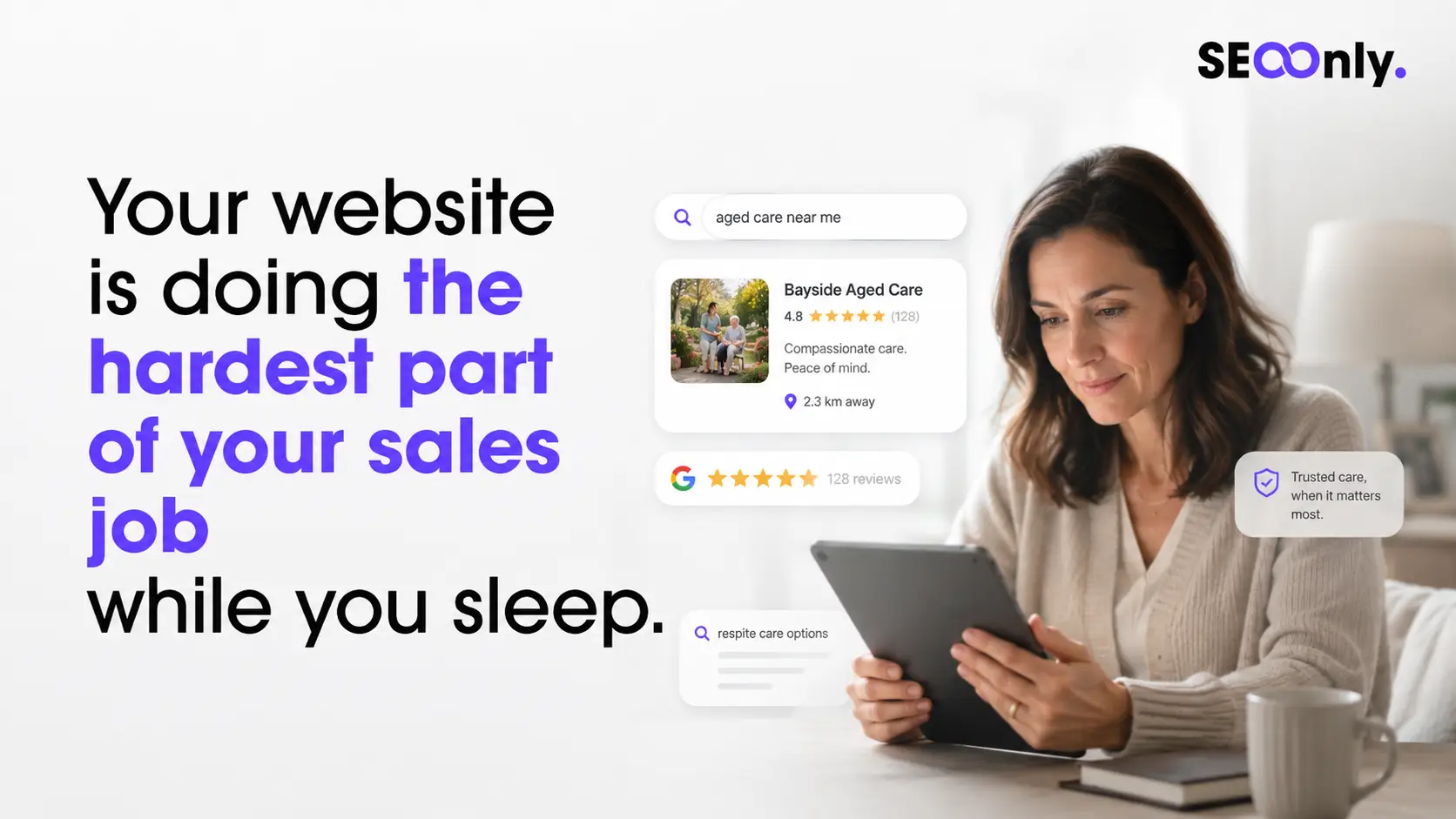
That means your online presence is doing the hardest part of your sales job while you sleep.
And people are thorough about it. BrightLocal’s 2026 research found 84% of people had searched for a local business online in the past three months, 73% did it on a mobile, and 75% used more than one channel before deciding. For aged care, that number is effectively everyone. A family will find you on Google, read your reviews, look you up on a directory, then circle back to your website. You have to hold up at every one of those touchpoints.
The search box is not the only front door anymore
There is a newer wrinkle, and it is worth understanding because it is growing fast.
A lot of families no longer start by typing “aged care near me” into Google. They open ChatGPT and just ask it, in plain words: “What should I look for in a good aged care home for my father in Brisbane?” And they read the answer it gives.
This is not a niche habit. ChatGPT reached 800 million people using it every week by October 2025, and 900 million by late February 2026, as reported by TechCrunch using OpenAI’s own figures. Google has changed too. You have seen those AI-written summaries now sitting at the top of the results, answering the question before any website gets a look in.
And they change behaviour. A study in the United States by the Pew Research Center found that when one of those AI summaries appears, people click through to an actual website only 8% of the time, compared with 15% when there is no summary. The answer gets read, and the person moves on.
So the goal has quietly shifted. It is no longer only “rank number one”. It is also “be one of the homes the AI names when a worried family asks it for help”.
The good news for aged care providers
Here is the part that should reassure you. Families do not blindly trust the robot, and they never will with something this important.
In that same BrightLocal research, only 18% of people felt ready to contact a business straight off an AI recommendation, and 43% of those who started with AI then went to Google to verify. Think about how much truer that is for aged care. Nobody hands over their parent on the say-so of a chatbot. They check. They read reviews. They look at your photos. They see whether your website answers the frightening questions honestly.
So you need to win at both ends: get named by the AI, and look genuinely trustworthy when the family double-checks. The signals that do one tend to do the other.
What actually gets an aged care home found and trusted
None of this is mysterious, and none of it needs a big budget. It needs consistency.
- A complete, accurate Google Business Profile. That is the free Google panel with your name, address, phone, hours and photos that shows up beside the results and in Maps. Whitespark’s ongoing research consistently ranks Google Business Profile signals and reviews among the strongest factors in local search. Get yours right, keep it current, and both Google and the AI tools lean on it.
- Recent, genuine reviews. BrightLocal found 84% of people use Google to find business reviews, and 96% of consumers are open to writing one. For a grieving or grateful family, a heartfelt recent review is worth more than any tagline you could write. Most homes simply never ask. Ask.
- Pages that answer the 2am questions. What does it cost? Is there a waitlist? Can Mum bring her cat? What happens when her needs increase? A page that answers those plainly beats a glossy “About Us” every time, and it gives the AI something clear to quote.
- Suburb-specific pages. A family searching in Geelong wants to see Geelong, not a generic national page. Name the areas you serve, in plain language.
A tale of two homes
Picture two aged care homes a few streets apart in Newcastle.
Home A has a lovely printed brochure. But its Google listing shows last year’s phone number, the newest review is from two years ago, and the fees page just says “contact us for pricing”.
Home B has a steady flow of recent, warm reviews, a listing that matches its website exactly, and a page that walks a family through costs and the move-in process in plain English.
Now that daughter in the dark asks an AI, or Google, “a caring aged care home near Newcastle that explains the costs clearly”. For Home A there is almost nothing to work with. For Home B, everything is right there. Same suburb. Completely different outcome. And none of it was luck.
What this means for you
The families you most want to reach are researching you at their most vulnerable, often alone, often late at night, long before they call. You do not get to choose the moment. You only get to decide whether you are ready for it.
That readiness is what AI-Powered SEO looks like for aged care. A spotless Google presence, a habit of gathering reviews, and a website that answers the real, frightening questions with honesty and warmth. No tricks. Just the right signals, shown consistently, so that when someone reaches for their phone at 2am, your home is one of the ones they find, and one of the ones they trust.
Want to know whether families, and AI tools, are finding your home when it matters most?
Get a complimentary AI visibility check from SEOOnly. No hard sell. No pressure. Get in touch.
Sources
- TechCrunch, “ChatGPT reaches 900M weekly active users” (Feb 2026): techcrunch.com
- Pew Research Center, “Google users are less likely to click on links when an AI summary appears” (US, Jul 2025): pewresearch.org
- BrightLocal, Consumer Search Behavior research (US, 2026): brightlocal.com
- BrightLocal, Local Consumer Review Survey (2025): brightlocal.com
- Whitespark, Local Search Ranking Factors: whitespark.ca
Related services
How SEOOnly can help
About the author
Vicky Miller
Head of SEO at SEOOnly
Vicky heads SEO at SEOOnly, helping businesses worldwide turn search visibility into measurable growth across Google and AI search. He writes on technical SEO, content strategy, and the shift to answer engines.
LinkedInLast updated September 8, 2026