If you read anything about AI and search lately, you have probably bumped into a strange little term. llms.txt. Usually with a headline telling you it is the next big thing and you are already behind.
So let us slow down and answer three simple questions. What is it? Does it actually do anything? And should you add one to your website this week?
No jargon. Just the straight version.
The short answer
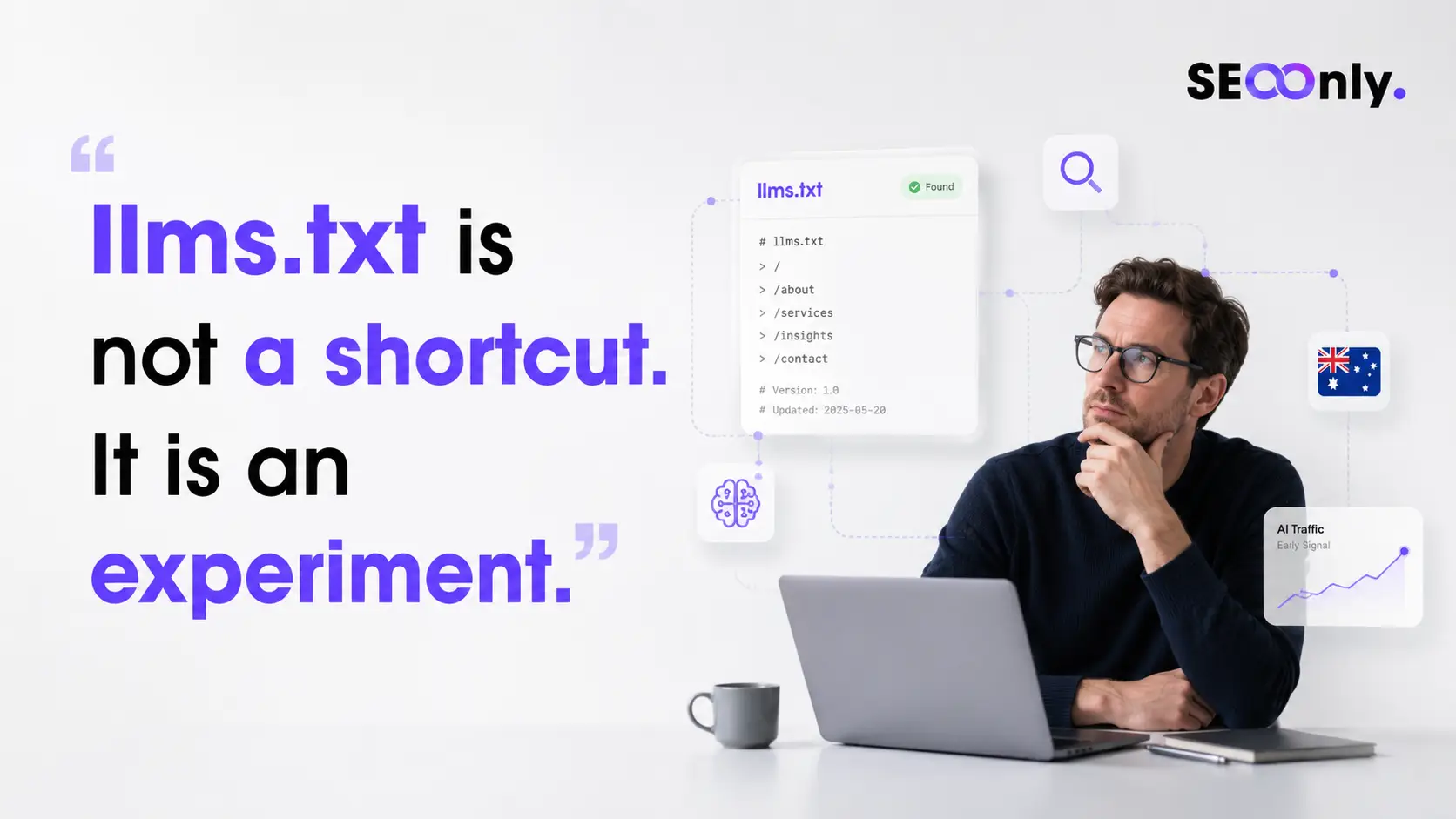
llms.txt is a small text file that sits on your website. Nothing more mysterious than that.
The idea came from Jeremy Howard, a well known Australian technologist, back in September 2024. Here is the thinking behind it.
Websites are messy places for a computer to read. They are full of menus, pop-ups, buttons and design that help humans but get in the way of an AI trying to find your actual words. An llms.txt file is meant to cut through that. It is a clean, plain summary of your site, pointing AI tools to your important pages and saying what each one is about.
Think of it like handing a new staff member a one-page cheat sheet instead of making them wander the whole building. That is the pitch.
How it is different from the files you may have heard of
People lump a few of these together, so here is the plain difference.
- robots.txt is a bouncer. It tells search engines which parts of your site they are not allowed into.
- A sitemap is an index. It is a list of all your pages so search engines can find them.
- llms.txt is a cheat sheet. It does not block anything and it is not just a list. It hands AI your key content in a tidy, easy-to-read form.
Worth knowing: even the people behind llms.txt say it is not a replacement for robots.txt. It sits alongside your other files, it does not override them.
And where does it go? Right at the top level of your website, so the address would be something like yourbusiness.com.au/llms.txt. Same idea as robots.txt, which has lived in that spot for years.
Now, here is the honest catch
This is where the hype gets ahead of reality, and we would rather tell you the truth than sell you a shortcut.
llms.txt is a suggestion, not an official rule. And right now, the big AI companies have not agreed to use it. Google has said publicly that it does not use llms.txt. There is no confirmed commitment from the others either.
Some companies do publish one. Anthropic, Perplexity and a few others have added the file. But “a few tech companies use it” is a long way from “the AI your customers use will read yours and reward you for it.” At this point, there is no strong proof that adding the file gets you mentioned more often in ChatGPT, Google’s AI answers, or anywhere else.
So if someone promises you that an llms.txt file will get your business into AI results, be sceptical. They are ahead of the evidence.
So should you add one?
Here is a sensible way to weigh it up.
- It is cheap. If you have someone technical, creating the file is quick and it does not hurt anything.
- The payoff is unproven. Do not expect it to change your visibility today.
- It is a small bet on the future. These things can catch on. Having one ready costs very little if it does.
Our honest advice for most Australian business owners? Do not let llms.txt distract you from the work that genuinely matters right now.
Think about it this way. If your website is slow, thin on detail, and your Google listing is out of date, an llms.txt file will not save you. It is a neat bow on a present that is not wrapped yet. Wrap the present first.
What actually helps AI find and recommend you
Here is the good news. The things that get you noticed by AI today are the same things that have always made a good website. Nothing exotic.
- Clear pages in plain language. Say what you do, where you do it, and answer the real questions customers ask.
- A strong, accurate Google listing. Your Google Business Profile, kept up to date, with genuine reviews.
- A fast, tidy website that both Google and AI tools can read without tripping over.
- Content that answers real questions. Costs, timelines, “how do I”, the stuff people actually type and ask.
Picture a plumber in Newcastle. He does not need a clever new file. He needs a website that clearly says he does emergency call-outs, covers his suburbs, and has forty happy reviews behind him. Get that right and the AI has plenty to work with. That is what AI-Powered SEO really looks like.
None of that is glamorous. That is exactly why it works. While your competitors chase the shiny new file, you quietly fix the things the AI is actually reading. Nine times out of ten, that is what gets a local business named in an answer.
The bottom line
llms.txt is a genuinely interesting idea from a respected Australian mind, and it is worth keeping half an eye on. But it is early, it is unofficial, and the big players have not signed up.
Treat it as a small, optional extra once your foundations are solid. Not as the magic thing that gets you into AI answers. Sort out your website, your Google listing and your reviews first. That is where the results are, today.
Keep an eye on llms.txt by all means. If the big platforms get behind it, adding one is a quick job. Until then, spend your energy where it actually pays off.
Want to know how AI-ready your website actually is?
Get a complimentary AI SEO check from SEOOnly. No hard sell. No pressure. Talk to our team.
Sources
- Search Engine Land, “Meet llms.txt, a proposed standard for AI website content crawling” (2025): searchengineland.com
- llms.txt official specification: llmstxt.org
Related services
How SEOOnly can help
About the author
Vicky Miller
Head of SEO at SEOOnly
Vicky heads SEO at SEOOnly, helping businesses worldwide turn search visibility into measurable growth across Google and AI search. He writes on technical SEO, content strategy, and the shift to answer engines.
LinkedInLast updated September 8, 2026